
What technical leaders need to get right before scaling AI across GTM
AI is now embedded across go-to-market work, from content creation and enablement to discovery and search.
For electronics companies in 2026, the opportunity is real. So is the risk.
In technical markets, one confident-sounding error can do more damage than ten strong campaigns can repair. AI can accelerate output, but it can also accelerate inconsistency if organizations do not define structure, sources, and accountability first.
That is why trust, not speed, has become the limiting factor.
A 2025 signal from engineering audiences that still shapes 2026 behavior
The 2025 State of Marketing to Engineers Report showed a clear shift toward digital-first, self-serve evaluation. Engineers increasingly rely on online content, search, and tools to form opinions well before engaging with a supplier.
The same research surfaced an important warning sign.
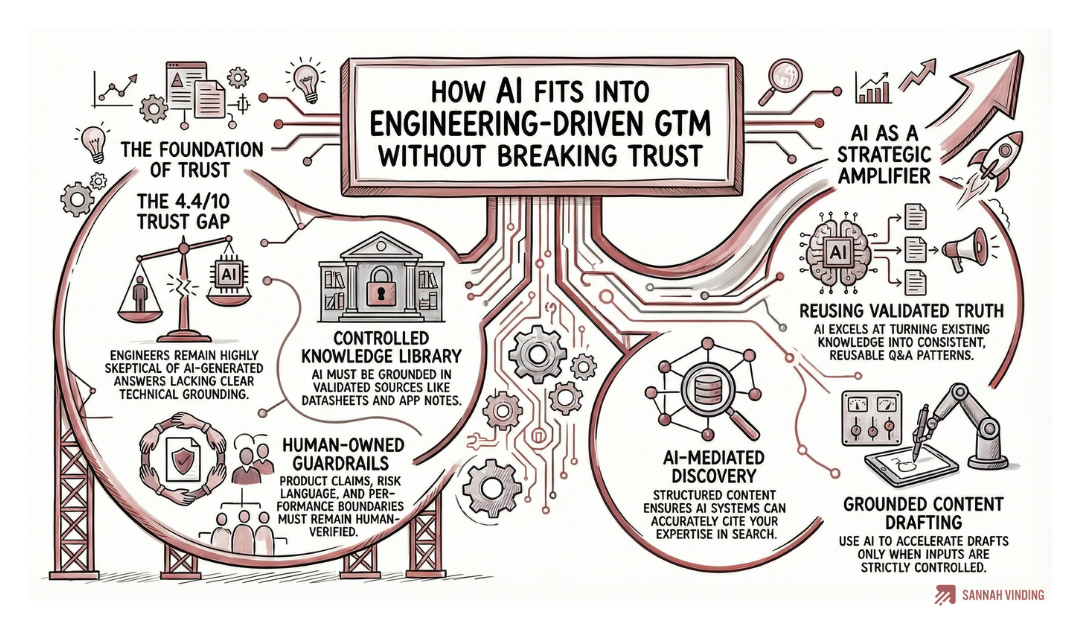
Engineering audiences rated their trust in generative AI answers at just 4.4 out of 10.
Source: TREW Marketing, 2025
That number matters even more in 2026.
As AI-mediated discovery expands across search, documentation, and recommendation systems, engineers are encountering AI-generated explanations more often. The data shows they are still skeptical. When answers lack clear sourcing, validation, or technical grounding, AI reduces confidence instead of increasing it.
In other words, AI is now part of how product credibility is formed.
A broader enterprise signal that reinforces the risk
This trust challenge is not limited to engineering audiences.
According to 2025 Gartner research, data quality and accuracy remain among the top barriers preventing organizations from realizing value from generative AI initiatives. As AI usage scales, organizations without strong governance experience more inconsistency, higher error rates, and declining confidence in outputs.
This insight directly impacts technical GTM in 2026.
AI capability is no longer the constraint.
System design, data ownership, and accountability are.
“Data quality and governance remain the primary barriers to realizing value from generative AI at scale.”
— Gartner, 2025
The core rule for 2026
AI should support systems, not replace judgment.
In electronics, accuracy, accountability, and traceable sources matter more than speed. Any GTM approach that treats AI as an autonomous author instead of a structured assistant will eventually damage trust.
Where AI genuinely helps in engineering-driven GTM
When used inside a clear operating model, AI can add meaningful leverage.
1) Structuring and reusing validated knowledge
AI is effective at organizing what is already true:
- Turning validated product knowledge into consistent Q&A patterns
- Supporting internal knowledge bases for marketing, sales, and FAEs
- Generating structured outlines for application pages and comparisons
The value comes from consistency and reuse, not invention.
2) Drafting and variation with strict grounding
AI can accelerate content creation when inputs are controlled:
- Drafting application explanations from approved technical sources
- Creating persona-specific versions that remain technically equivalent
- Producing first drafts of enablement content for expert review
This only works when source material is explicit and review ownership is clear.
3) Improving discovery in AI-mediated channels
AI is changing how technical information is surfaced. Engineers increasingly encounter answers through:
- AI-powered search experiences
- Technical Q&A interfaces
- Automated summaries and recommendations
To remain discoverable without being distorted, content must be structured, specific, and consistently grounded in product truth.
“Organizations grow faster when go-to-market teams are aligned around clear ownership and execution, not additional spend or activity.”
— Forbes, 2025
What must remain human-owned
AI should not be the authority on:
- Product claims and performance boundaries
- Competitive positioning and trade-offs
- Reliability statements and risk language
- What is safe to promise in a technical context
These decisions require accountable owners, typically product and engineering leadership, with product marketing translating for the market.
The governance layer most teams still miss
In 2026, AI becomes useful only when governance is simple and enforceable:
- A controlled library of approved sources such as datasheets, app notes, and validated test reports
- Clear ownership for review and sign-off
- Defined rules for what AI can draft versus what must be written by humans
- A process to update content as products, specs, or qualifications change
Without governance, AI increases output while decreasing trust.
“AI only creates leverage in electronics when it is built on product truth, clear ownership, and engineering accountability. Without that structure, it simply scales confusion.”
— Sannah Vinding
AI is not a shortcut to GTM success in electronics.
It is an amplifier of whatever system already exists.
If your GTM structure is grounded in product truth and clear ownership, AI increases speed and consistency without breaking credibility. If the structure is unclear, AI will scale confusion.
Trust remains the constraint in 2026.
Engineering-driven GTM is how organizations protect it while gaining leverage.

Sannah Vinding
Engineer and B2B Marketing Strategist
I’m an engineer with global experience across electronics product development and go-to-market leadership. My work focuses on aligning engineering reality, marketing structure, and modern AI tools so technical organizations can communicate clearly and execute with confidence.
Follow for engineering-driven insight on AI, go-to-market strategy, and B2B growth in complex technical industries.