
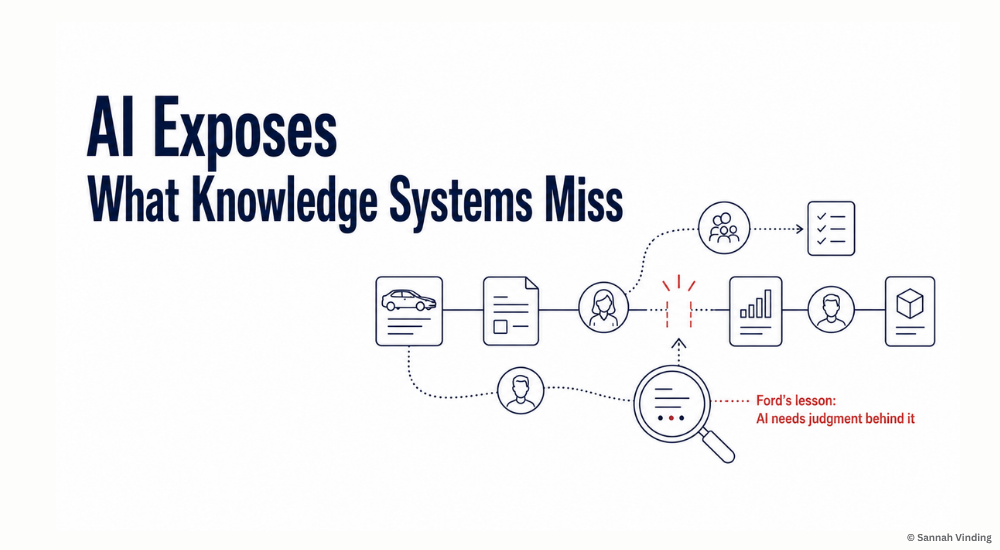
When knowledge gets stuck, AI exposes it
In technical B2B organizations, growth often breaks where knowledge gets stuck.
Product knowledge lives in one place. Customer insight lives somewhere else. Engineering expertise sits with experienced people. Sales hears what buyers are questioning. Support sees where confusion shows up after the sale. Marketing is trying to turn all of that into a clear story the market can understand.
When that knowledge does not move clearly, customers feel it. They see inconsistent information, hear different versions of the product story, and have to work harder than they should to understand what is true.
That is already a growth problem.
Gartner found that 69% of B2B buyers report inconsistencies between supplier website information and what sales reps provide. That is not just a sales or marketing issue. It is a knowledge-system issue.
AI raises the stakes because it can move information faster, but it does not automatically make that information clearer, more accurate, or more trustworthy. If the knowledge system is weak, AI does not fix the foundation. It exposes it.
That is the useful lesson I see in Ford’s recent quality reset, which was also reflected in J.D. Power’s 2026 U.S. Initial Quality Study.
The lesson is not simply that “AI failed.” That is too easy, and it misses the more important point. The better lesson is that AI cannot replace institutional knowledge that was never fully captured, transferred, or governed.
That matters for engineering-led companies, technical B2B organizations, manufacturers, distributors, and any team trying to use AI to move faster without losing the judgment that makes the work good.
The real question is not only, “Can AI help with this task?”
The better question is, “What expertise does this task depend on, and have we captured enough of it for AI to support the work safely?”
“AI does not fix scattered knowledge. It exposes where the system was already unclear.”
Sannah Vinding
AI can support the work, but it cannot invent missing context
In technical organizations, a lot of important knowledge does not live neatly in one system. It lives in experienced people, customer conversations, engineering tradeoffs, product history, support tickets, application notes, old launch decisions, and the way teams have learned to solve problems over time.
Some of that knowledge is documented. A lot of it is not.
It lives in the engineer who knows when a design technically passes, but still feels wrong. It lives in the product manager who understands which customer requirement is actually critical and which one is just noise. It lives in the sales engineer who knows why one application needs a different explanation than another. It lives in the operations leader who can see a process breakdown coming before the dashboard turns red.
That type of knowledge is not always easy to search. It is not always written in a way that a tool can use. It may not even be recognized as knowledge because the experienced person in the room has always carried it.
So when companies try to automate too quickly, AI does not just speed up the work. It reveals what was never clear in the first place.
The missing review loop. The unclear ownership. The undocumented decision rule. The outdated product story. The tribal knowledge. The customer context that never made it back into the system.
That is where AI becomes less of a tool question and more of a leadership question.
The Ford story is not just an AI story. It is a knowledge-system story.
AI can help with technical work, but only when the judgment, context, and review loops around the work are strong enough to trust.
Source: Business Insider, J.D. Power 2026 U.S. Initial Quality Study
The risk is not using AI. The risk is using AI on top of weak systems.
I do not think the answer is to avoid AI. That is not realistic, and it is not the point.
AI can be incredibly useful. It can summarize information, compare documents, draft first versions, surface patterns, organize research, help teams find things faster, and reduce a lot of friction. In complex B2B environments, that matters. Teams are often working across too many systems, too many handoffs, and too many versions of the truth.
But AI is only as useful as the system around it.
McKinsey’s research shows why that gap matters. The firm found that 78% of organizations use AI in at least one business function, but only 21% of organizations using generative AI have fundamentally redesigned at least some workflows. In other words, many companies are adding AI before they have redesigned how the work should actually move.
If the inputs are unclear, the output will be unreliable. If ownership is unclear, no one knows who is responsible for checking the work. If the process is broken, AI may simply help the broken process move faster. If product knowledge is scattered across people, files, inboxes, presentations, and old conversations, AI may surface something, but it may not know what is current, approved, accurate, or useful to the customer.
This is why I keep coming back to the same point: AI can accelerate a system, but it cannot replace the need to understand the system.
If the direction is unclear, faster does not automatically create better outcomes. Sometimes it just spreads confusion more efficiently.
78% of organizations use AI in at least one business function, but only 21% of organizations using generative AI have fundamentally redesigned at least some workflows.
Source: McKinsey
Institutional knowledge has to become usable knowledge
A lot of companies already have the knowledge they need. The problem is that the knowledge is not always usable across the business.
Engineering knows what the product can really do. Product understands the tradeoffs. Sales hears what customers are comparing. Support sees where confusion shows up after implementation. Marketing understands where the story needs to be clearer. Leadership sees the market pressure.
But if all of that stays disconnected, the company keeps recreating the same work.
A product launch takes longer because the core story has to be rebuilt from scratch. A sales team creates its own explanation because the official version does not answer what buyers are actually asking. A customer hears one message on the website and another in a sales conversation. Marketing creates content from partial information. Product teams miss signals because customer insight never makes it back into the workflow.
Then AI gets added to the same environment.
That is when the risk increases. Not because AI is bad, but because AI depends on the quality, clarity, and structure of the knowledge it is being asked to use.
If the system has five versions of the product story, AI does not automatically know which one to trust. If the best explanation lives in someone’s head, AI cannot use it unless that knowledge has been captured. If customer context is missing, the answer may sound polished but still miss the real need.
This is why institutional knowledge has to become usable knowledge.
Not just stored. Usable.
Not just documented once. Kept current.
Not just available somewhere. Easy for the right people to find, apply, validate, and improve.
“Knowledge only helps when people can find it, trust it, and use it in the work.”
Sannah Vinding
Before automation, map the judgment
One of the most practical steps a team can take before applying AI is to map where judgment actually lives in the work.
Not just the process steps. The judgment points.
Where does someone decide whether an output is good enough? Where does customer context change the answer? Where does engineering experience matter? Where does product truth need to be protected? Where does risk increase if the wrong answer moves forward? Where does a human need to validate, challenge, or approve the result?
This is especially important in technical B2B because the value is often in the nuance. The answer is not always generic. It depends on the application, the environment, the buyer’s role, the technical requirement, the commercial tradeoff, and the level of risk involved.
That does not mean AI cannot help. It means AI has to be placed in the right part of the workflow.
Some work can be automated. Some work can be assisted. Some work needs to be protected because it depends on judgment, accountability, customer trust, or technical accuracy.
The mistake is treating all work as if it is the same.
The useful AI-readiness questions
If a company is looking at where AI belongs, I would start with questions like these:
- What decision is being made here?
- What information does that decision depend on?
- Who has that knowledge today?
- Is it documented, current, and easy to find?
- Where do teams use different versions of the same answer?
- What part of the work is repetitive or friction-heavy?
- What part requires customer context, technical judgment, or accountability?
- Who reviews the AI-assisted output?
- What happens if the output is wrong?
- What should AI prepare, and what should people still own?
That last question matters because AI can help with the first mile of the work. It can help gather, organize, summarize, compare, and draft.
But the last mile still belongs to people.
The last mile is where someone decides whether the answer is accurate, useful, trustworthy, and appropriate for the customer or decision in front of them.
AI readiness is knowledge readiness
AI readiness is often talked about as a technology issue. What tools should we use? Which platform is best? How do we train people? Where can we automate?
Those questions matter, but they are not enough.
For technical B2B companies, AI readiness is also knowledge readiness.
Do we know what we know? Do we know where it lives? Do we know who owns it? Do we know what is current? Do we know what buyers need to understand before they trust us? Do we know which decisions require experience, not just information?
If the answer is no, AI may still help, but it will also show where the organization is not ready yet.
That is not a reason to stop. It is a reason to build the right layer around the work.
Clear product truth. Better documentation. Stronger review loops. Defined ownership. Workflow design. Human judgment where it matters most.
Those are not separate from AI adoption. They are what make AI adoption useful.
The point
The future is not AI instead of expertise.
The future is expertise made easier to find, use, validate, and apply.
That is the real opportunity for technical B2B organizations. Not removing experienced people from the system. Not pretending judgment can be automated because the task looks repeatable. Not confusing faster output with better decisions.
The opportunity is to take the expertise that already exists inside the organization and make it more usable across the work.
That is also why engineering-driven growth cannot only be about better campaigns or sharper messaging. It has to include the systems that help knowledge move: from engineering to product, from sales to marketing, from customer conversations back into positioning, and from internal expertise into external clarity.
AI can support that system.
But it cannot replace the need to build it.
And that is where the leadership work starts.

Sannah Vinding
Engineer | Product Marketing & GTM Systems Leader
I’m an engineer and go-to-market leader with experience across electronics, semiconductors, and advanced manufacturing. I build product marketing, market visibility, and go-to-market systems that connect engineering expertise, customer needs, and commercial growth.
My work focuses on product marketing, AI-enabled execution, customer discovery, and the frameworks that help technical organizations make better decisions, improve execution, and strengthen market visibility.
If this resonated, read these next
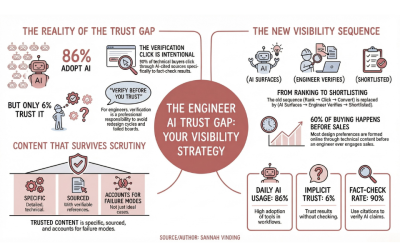
Why Engineers Don’t Trust AI (And What That Means for Your Visibility)
86% of engineers use AI. Only 6% trust it. Learn how electronics manufacturers can turn the engineer trust gap into a B2B visibility advantage
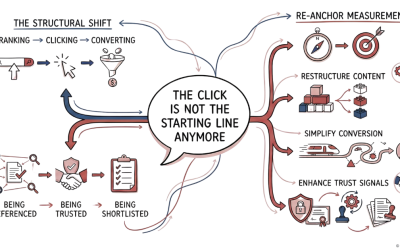
The Click Is Dying. Long Live the Shortlist.
AI answers are reducing clicks, but the visitors who still arrive are often more qualified. Learn how manufacturing teams should shift from ranking and traffic to referenceability, trust, shortlists, and conversion optimization.
Follow for engineering-driven insight on AI, go-to-market strategy, and B2B growth in complex technical industries.