
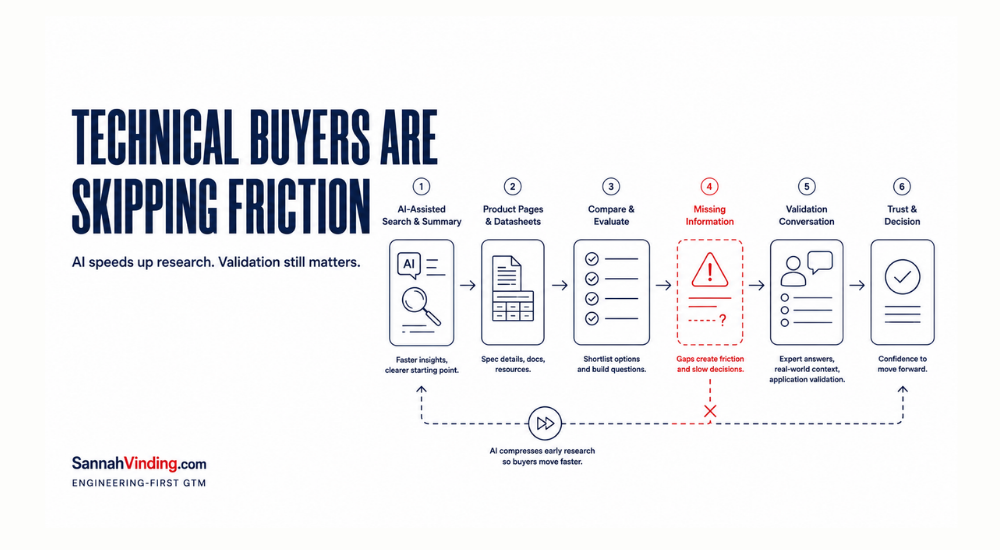
Technical Buyers Are Skipping Friction
There is a common misunderstanding in many AI conversations.
Because AI can summarize, compare, search, and recommend faster than people can manually sort through information, it is easy to assume buyers are becoming less careful.
In technical B2B, I do not think that is the right way to look at it.
Engineers are not skipping validation. They are skipping friction.
That distinction matters.
A technical buyer still needs to understand whether a product, supplier, or solution will work in the real situation in front of them. They still need to compare tradeoffs, check specifications, understand risk, involve the right people, and make sure the decision can hold up later.
AI does not remove that responsibility.
But it can change how much manual effort sits in front of it.
“AI can help buyers get to better questions faster. But trust still depends on clear information, credible proof, and human validation.”
Sannah Vinding
AI can compress the early evaluation work
In many technical buying processes, a lot of time is spent before anyone is ready to talk to sales.
Buyers search. They compare. They read datasheets, product pages, application notes, documentation, reviews, discussion threads, distributor pages, and supplier websites. They ask colleagues. They look for similar use cases. They try to understand what is credible and what is just marketing language.
AI can compress parts of that work.
It can help a buyer:
- summarize supplier information
- compare product options
- pull out key specifications
- identify missing details
- draft better technical questions
- organize research across multiple sources
- narrow a long list into a shorter list
- prepare for a more useful conversation with a supplier
That does not mean the buyer has made the decision.
It means the buyer may arrive at the validation stage faster, with better questions and fewer reasons to tolerate unclear information.
This is where technical companies need to pay attention.
If your information is hard to find, inconsistent, outdated, too generic, or split across too many places, AI does not magically make it easier to trust. It may expose the gaps faster.
Engineers are not skipping validation. They are skipping friction.
AI can help buyers compare options faster, but technical trust still depends on clear information, credible proof, and people who can validate the decision.
Source: McKinsey 2025 State of AI Research
Faster research does not mean less serious evaluation
Technical buyers are not evaluating a simple purchase.
They are often looking at fit, reliability, availability, integration, compatibility, performance, lifecycle risk, support, and long-term consequences. A bad decision can create design delays, quality issues, customer problems, production friction, or internal rework.
So the validation work does not disappear.
What changes is the path buyers take to get there.
Gartner reported in 2026 that 67% of B2B buyers prefer a sales-rep-free experience, while 70% prefer a completely digital, self-service buying experience. Gartner also found that 45% of buyers used GenAI in a recent purchase, mainly to gather information about vendors and products.
That does not mean sellers no longer matter.
In a separate Gartner finding, 69% of B2B buyers said they prefer to validate AI-generated insights with sales reps. Buyers used an average of seven information sources during a recent purchase.
That combination says a lot.
Buyers want more control over the early research process. They want to move at their own pace. They want digital access. They are starting to use AI as part of vendor and product research.
But they still need validation.
They still need confidence.
They still need people at the right moments, especially when the decision is complex, risky, or hard to interpret through self-service information alone.
69% of B2B buyers prefer to validate AI-generated insights with sales reps.
Source: Gartner
The role of sales changes when buyers arrive better prepared
This is not a story about sales becoming irrelevant.
It is a story about sales showing up differently.
If a buyer has already used AI to compare options, summarize supplier claims, identify missing information, and prepare questions, the first human conversation changes.
The buyer may not need a basic overview.
They may need help understanding whether the product fits their application. They may need context around tradeoffs. They may need a more honest conversation about limitations, constraints, support, availability, or implementation. They may need someone who can connect the technical details to the business or operational reality.
That is a different kind of sales conversation.
It is less about being the first source of information and more about becoming a trusted source of validation, clarity, and judgment.
For technical companies, that means the work starts before the sales call.
Your website, product pages, documentation, distributor presence, sales collateral, technical content, and public expertise all shape the buyer’s understanding before a person from your company enters the conversation.
If those touchpoints do not line up, the buyer feels the friction.
“Technical buyers are not skipping validation. They are skipping the friction that makes validation harder.”
Sannah Vinding
Friction becomes part of the buying experience
In technical B2B, friction is not always obvious from inside the company.
Internally, every team may think the information exists somewhere.
Engineering knows the technical truth. Product knows the roadmap and tradeoffs. Sales hears the customer questions. Support sees the confusion after the sale. Marketing is trying to turn all of it into a clear market story.
But the buyer does not experience your internal knowledge that way.
The buyer experiences what they can find, compare, understand, and trust.
If the product page says one thing, the datasheet says another, the distributor listing is incomplete, the sales deck uses a different message, and the technical proof is buried in a PDF from three years ago, that is not just a content issue.
It is buyer friction.
And in an AI-mediated market, that friction can show up earlier.
The buyer may not wait for a sales conversation to sort it out. They may move on to the company that makes the evaluation easier.
Not because that company has the best slogan.
Because that company made the next step clearer.
Clarity is part of trust
Technical buyers do not need everything simplified to the point of being shallow.
They need useful clarity.
They need to understand what the product does, where it fits, what problem it solves, what the tradeoffs are, what proof exists, and when they should ask for help.
That is not just marketing work.
It is go-to-market system work.
It requires product truth, technical proof, commercial context, and human trust to line up across the places buyers are already looking.
AI can help buyers gather and organize information, but it cannot create trust out of inconsistent inputs.
This is also why AI adoption inside the company cannot be separated from workflow and knowledge quality. McKinsey’s 2025 State of AI research found that 78% of organizations use AI in at least one business function, but only 21% of organizations using generative AI have fundamentally redesigned at least some workflows.
That gap matters.
If companies layer AI on top of scattered information, unclear ownership, and inconsistent customer-facing knowledge, they may move faster without becoming clearer.
The same is true externally.
If buyers use AI to evaluate the market, the companies with clearer, more consistent, more trustworthy information have an advantage.
Not because AI makes the decision for the buyer.
Because AI helps the buyer get to the real questions faster.
The useful leadership question
The useful question is not, “Will AI replace technical sales?”
That is too narrow.
The better question is:
Are we making it easier for technical buyers to understand, compare, validate, and trust us before they ever talk to sales?
That question touches more than marketing.
It touches product data. Documentation. Technical proof. Sales enablement. Customer insight. Distributor information. Website structure. Internal knowledge sharing. Review processes. Ownership. And the way human expertise becomes reusable knowledge.
Because the last mile is still human.
People still own judgment, validation, trust, and the customer promise.
But the path to that last mile is changing.
Engineers are not skipping validation.
They are skipping friction.
And the companies that make technical evaluation easier will have an advantage before the first sales conversation.

Sannah Vinding
Engineer | Product Marketing & GTM Systems Leader
I’m an engineer and go-to-market leader with experience across electronics, semiconductors, and advanced manufacturing. I build product marketing, market visibility, and go-to-market systems that connect engineering expertise, customer needs, and commercial growth.
My work focuses on product marketing, AI-enabled execution, customer discovery, and the frameworks that help technical organizations make better decisions, improve execution, and strengthen market visibility.
If this resonated, read these next
Preference Forms Before Sales Is Invited
AI is changing when technical buyers form preferences. Sales still matters, but buyers may compare, shortlist, and trust suppliers before the first conversation.
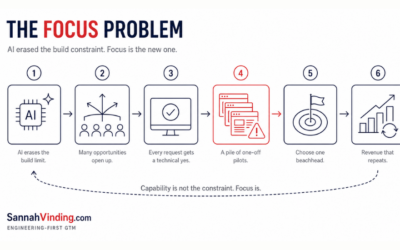
The Focus Problem: Why Electronics B2B Companies Stall After AI
AI removed the build constraint in electronics. Now focus decides which
B2B tech companies and manufacturers turn capability into repeatable revenue and
growth.
Follow for engineering-driven insight on AI, go-to-market strategy, and B2B growth in complex technical industries.