
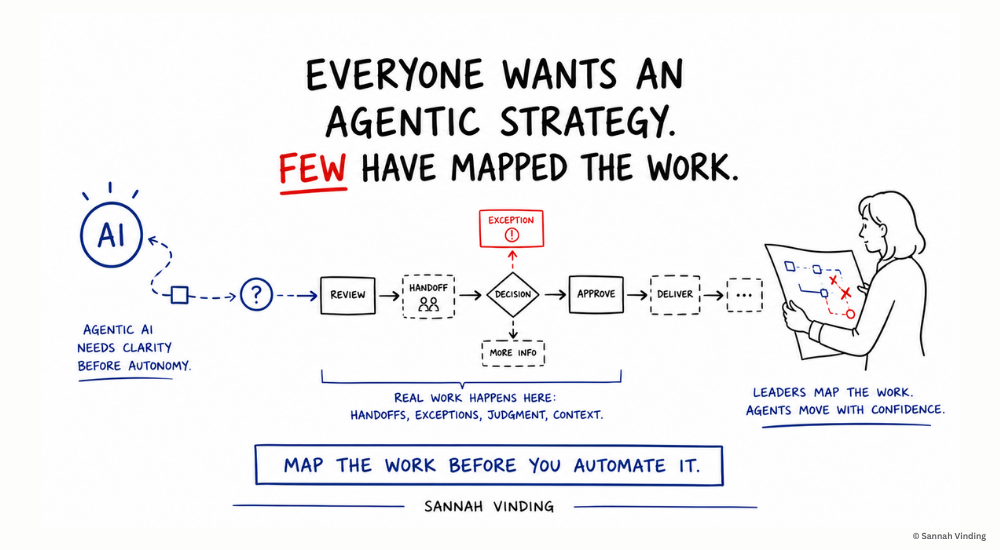
Agentic AI is becoming the new strategy conversation
The language is everywhere: agents, digital workers, autonomous workflows, orchestration, human-in-the-loop systems. Some of it is useful. Some of it is premature.
Because before a company decides where agents belong, it has to understand how work actually gets done today.
Not the workflow in the onboarding deck. Not the process map that looks clean in a system diagram. The real work. The handoffs, exceptions, judgment calls, workarounds, spreadsheet checks, customer context, and experienced people who know why the official process is only part of the story.
Deloitte makes this point directly in its agentic AI strategy research, noting that many enterprises are moving quickly toward agentic AI but hitting a wall because they are trying to automate existing processes without reimagining how the work should actually be done.
That is the risk.
The useful question is not, “Where can we add agents?”
The useful question is, “Where does the work actually break?”
77% of executives are actively identifying high-value processes where autonomous AI judgment can be deployed. The opportunity is real, but the work still has to be mapped first.
Source: IBM Institute for Business Value,
The Workflow on Paper Is Not the Same as the Work
Most organizations have documented processes. That does not mean they have mapped the work.
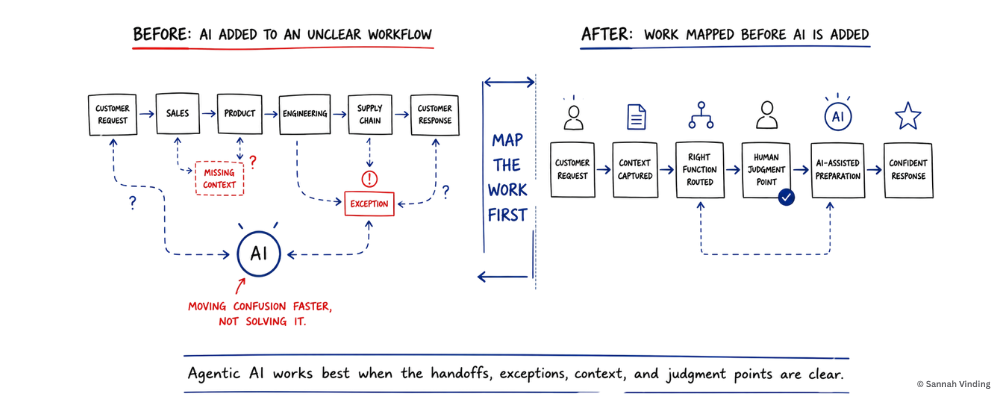
A documented process shows the official steps. Real work includes what happens between those steps. It includes the customer question that does not fit the form. The engineering review that happens over chat because the system does not capture enough context. The sales handoff that works only because one person knows the account history. The supply issue that requires someone to interpret what the data means before the customer can get a useful answer.
In technical B2B environments, work is rarely as linear as the process suggests.
A customer request might move through sales, product, engineering, supply chain, quality, operations, and finance before anyone can give a confident answer. Each function may have part of the information. Each system may tell part of the story. Each person may know something that never makes it into the official record.
This is where agentic AI gets complicated.
If the work is unclear, an agent will not make it clearer. It will move the confusion faster.
That is why workflow mapping matters. Not as a documentation exercise, but as a leadership discipline. Leaders need to know where work starts, who touches it, what systems are involved, what decisions are being made, where delays happen, and which exceptions require human judgment.
Without that map, an agentic strategy can automate the visible steps while missing the hidden work that makes the process function.
“The useful question is not, “Where can we add agents?” The useful question is, “Where does the work actually break?”
Sannah Vinding
Agents Need Context Before They Need Autonomy
Agentic AI is often described by what it can do: take action, coordinate steps, interact with systems, monitor changes, escalate issues, or complete tasks with less human prompting.
Those capabilities matter. But they also raise the standard for clarity.
An agent needs more than a task. It needs boundaries.
It needs to know what information it can use, what systems it can touch, what decisions it can make, when it should stop, when it should ask for review, and when the work needs a human expert.
86% of executives say that by 2027, AI agents will make process automation and workflow reinvention more effective. That makes workflow clarity a leadership priority, not a technical detail.
Source: IBM Institute for Business Value
Bain’s State of the Art of Agentic AI Transformation describes the shift from broad productivity tools toward AI embedded in functional workflows. Bain also notes that value compounds when AI is deeply embedded in workflows, supported by data cleaning, curation, and governance.
That matters because agentic AI is not just another layer on top of messy operations. It depends on the quality of the work system around it.
If the data is unreliable, the agent inherits the problem.
If handoffs are unclear, the agent may route work faster without improving the outcome.
If decision rights are fuzzy, the agent can create more friction instead of less.
If exceptions are undocumented, the agent may treat rare but important judgment calls as routine tasks.
This is especially important in electronics, manufacturing, and technical B2B markets where decisions often involve product fit, qualification requirements, availability, compliance, customer history, supplier constraints, and engineering judgment.
The work is not only administrative. It is contextual.
Leaders need to decide where AI should automate, where it should assist, and where human judgment needs to stay protected.
“Agentic AI does not remove the need to understand the process. It raises the cost of not understanding it.”
Sannah Vinding
Automate, Assist, or Protect
A practical agentic strategy starts by separating work into three categories.
First, what should be automated?
This is repeatable, low-risk, well-defined work. It has clear inputs, clear outputs, stable rules, and limited downside if the task is completed consistently. Agents can help here when the process is already understood and the data is reliable.
Second, what should be assisted?
This is where many technical teams may see the most value first. Research, summarization, routing, monitoring, comparison, draft creation, and preparation are all areas where AI can reduce friction without removing human responsibility.
A sales team might use AI to prepare for an account conversation. A product marketer might use it to compare customer questions across segments. An FAE might use it to summarize application notes before reviewing a customer issue. A supply chain team might use it to monitor signals and prepare exception summaries.
The human still owns the judgment. AI improves the preparation.
Third, what should be protected?
This is the work where context, trust, ethics, technical judgment, customer impact, or business risk matters too much to hand off without oversight. It includes decisions that require trade-off thinking, relationship awareness, exception handling, or accountability.
This is where many companies need the most discipline.
The goal is not to keep people in every loop because the organization is afraid of AI. The goal is to keep people in the right loops because the work depends on judgment.
IBM’s Institute for Business Value describes agentic workflows as a blend of human judgment, real-time orchestration, and AI autonomy. That is a useful way to think about it. The future is not all-human or all-agent. It is a designed system where the responsibilities are clear.
The Agentic Strategy Is a Work Strategy
The companies that get value from agentic AI will not be the ones with the longest list of possible agents.
They will be the ones that understand the work well enough to know where an agent belongs, where a human needs to stay in the loop, and where the process itself needs to change first.
That requires leaders to ask better questions.
Where does work slow down?
Where do people repeat the same manual steps?
Where do decisions wait because context is missing?
Where do teams rely on one experienced person to interpret the situation?
Where does data exist, but not where the decision happens?
Where do customers feel the gap between what the process says and what they actually need?
These are not just technology questions. They are leadership questions.
Agentic AI can help companies move faster, but speed is only useful when the direction is clear. If the workflow is poorly understood, automation can scale the wrong behavior. If the decision points are unclear, autonomy can create risk. If the human judgment layer is ignored, trust can erode.
Before leaders build an agentic strategy, they need to map the work.
The real work.
The work people actually do to move decisions forward, serve customers, solve exceptions, and connect information across functions.
That is where the strategy should start.
Because agentic AI does not remove the need to understand the process.
It raises the cost of not understanding it.
AGENTIC AI IS A LEADERSHIP DECISION
The agentic AI gap will not be between companies that have agents and companies that do not. It will be between leaders who understand how work actually gets done and leaders who automate the process they think exists. The last mile is still human, and that is where judgment, context, and trust determine whether AI creates value or simply moves confusion faster.

Sannah Vinding
Engineer and Go-To-Market Leader
I’m an engineer and go-to-market leader with global experience across electronics and semiconductor businesses. I work at the intersection of product, engineering, and marketing, translating technical detail into clear positioning, usable content, and GTM systems that teams actually use. My focus is on practical execution, product clarity, and applying AI where it removes friction rather than adding noise.
If this resonated, read these next
Most Growth Problems Are System Problems
In technical B2B organizations, growth often depends less on one campaign or message and more on how well product knowledge, customer insight, technical expertise, and commercial execution connect across the business.
AI Changes the Work Before It Changes the Job Title
AI is changing tasks, workflows, and decision points before job titles. For electronics supply-chain leaders, the last mile still needs human judgment.
Follow for engineering-driven insight on AI, go-to-market strategy, and B2B growth in complex technical industries.