
WHY SaaS GO-TO-MARKET MODELS FAIL IN ELECTRONICS
The engineering-driven GTM model electronics need in 2026
If you look at the organizational charts of most electronics manufacturers today, you will find a Go-To-Market (GTM) structure that looks suspiciously like it was borrowed from a Silicon Valley software company. Marketing does “awareness,” Sales does “conversion,” and Product throws new specs over the wall every quarter hoping something sticks.
That model works for software. It fails for hardware.
In the electronics industry, companies rarely fail because they lack intelligence or effort. They fail because their operating model is unclear.
As we enter 2026, the physics of our market have shifted. Buying behaviors are 70% digital, AI has become the primary gatekeeper of visibility, and the supply chain is flashing warning signs of renewed volatility.
If your GTM strategy relies on tribal knowledge, siloed handoffs, and generic “campaigns,” you aren’t just inefficient—you are invisible. It is time to dismantle the “funnel-based” approach and build an Engineering-Driven GTM Structure.
Here is the diagnosis of why the old model died, and the specific framework you need to engineer your way back into the market for 2026.
The Signal Integrity Problem: Why the Old Playbook Failed
To an engineer, a system failure is rarely about one bad component; it is about impedance mismatches. In 2026, there is a massive impedance mismatch between how manufacturers sell and how engineers buy.
- The “Invisible” Evaluation (The Zero-Click Reality) For decades, we relied on a predictable signal chain: an engineer had a problem, searched for a keyword, clicked your website, and downloaded a datasheet. That chain is broken.
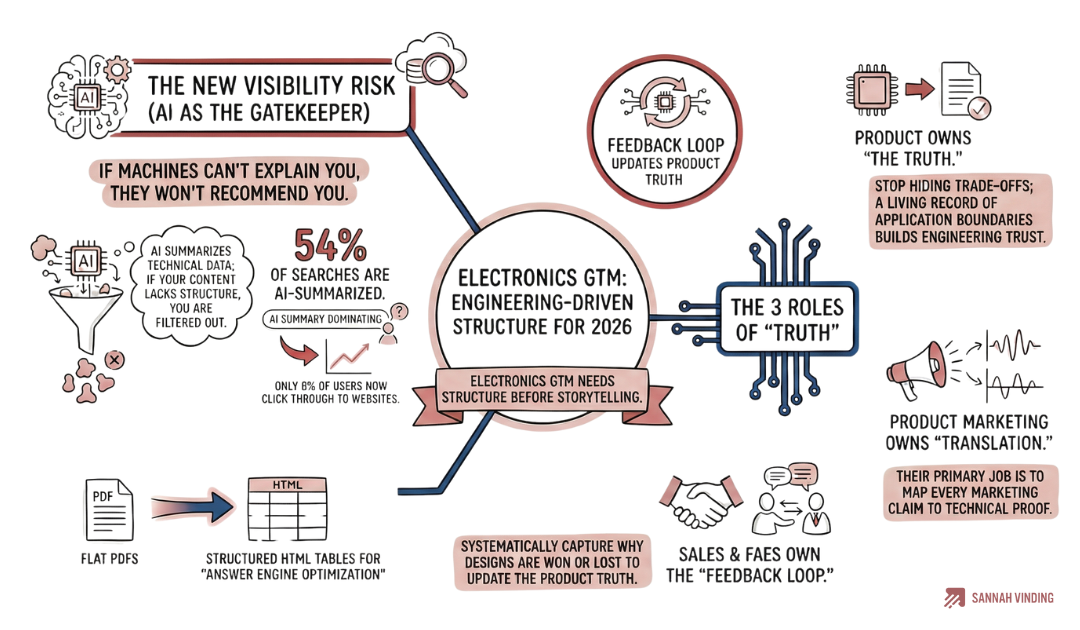
- The Data: 54% of Google searches now result in AI-generated summaries that satisfy user intent immediately.
- The Result: When these summaries appear, only 8% of users click through to your site.
- The Implication: Your content isn’t being read by humans first; it’s being read by Large Language Models (LLMs). If your GTM strategy doesn’t structure technical data for machine interpretation, you are being filtered out before the race begins.
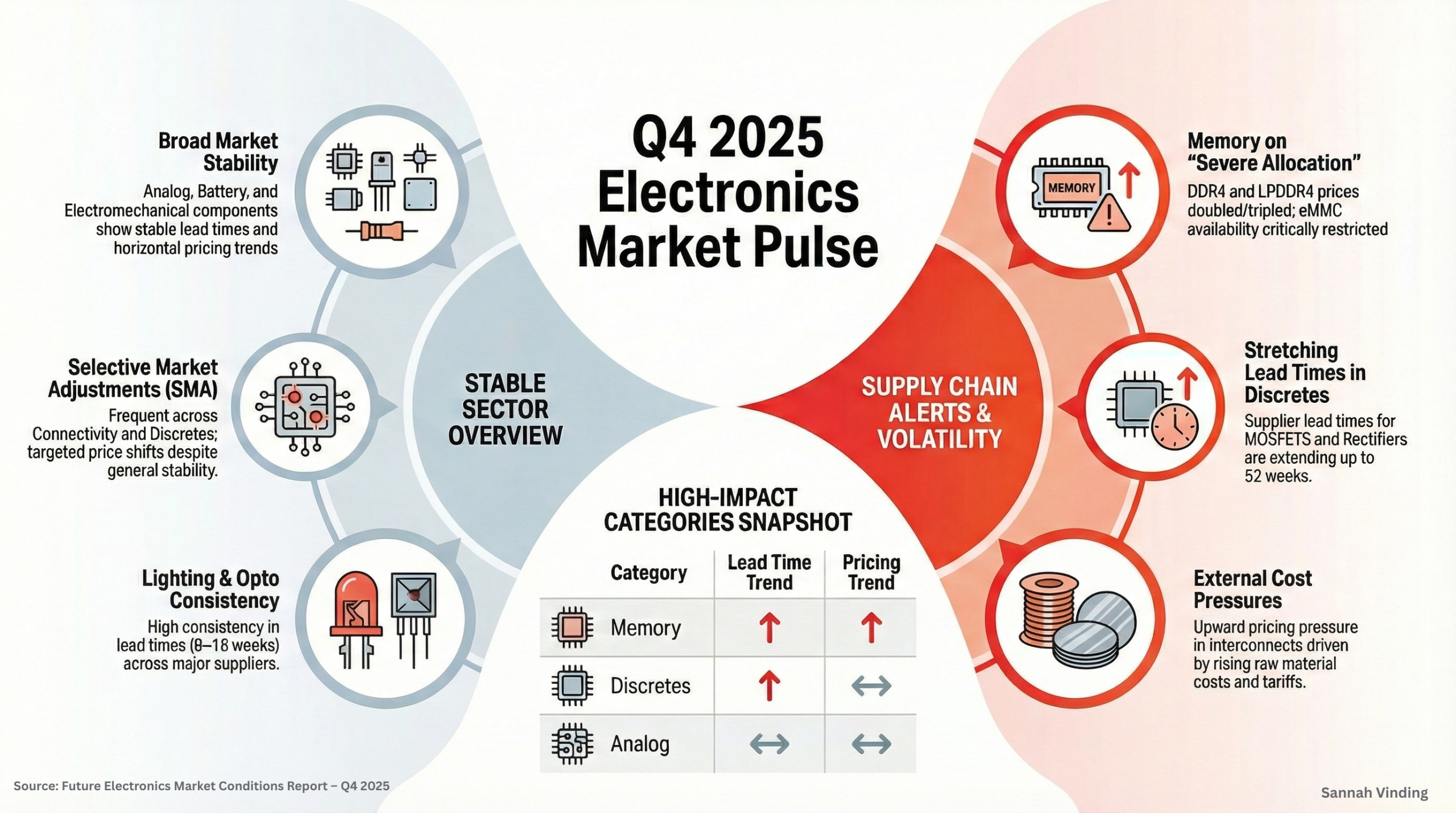
- The Return of Volatility (The Supply Chain Reality) If you are still marketing based on 2025’s stability, you are walking into a trap. The Q4 2025 Market Conditions Report screams caution.
- Memory Crisis: DDR4 and LPDDR4 prices have doubled or tripled, and eMMC is on severe allocation,.
- Discrete Bottlenecks: Lead times for MOSFETs and Rectifiers from major suppliers are stretching to 52 weeks,.
- The Implication: You cannot market “innovation” if you cannot deliver “reliability.” A GTM model that pushes demand for allocated parts destroys trust faster than any competitor could.
SaaS GTM models break in electronics because engineers evaluate before they engage.
By the time sales enters, trust is already formed or lost.
The Framework: An Engineering-Driven Operating System
An “Engineering-Driven GTM” does not mean engineers run marketing. It means the system is designed around engineering reality, where accurate specs, trade-offs, and proof matter more than persuasion.
In technical markets, structure is strategy because structure determines what the buyer believes. To succeed in 2026, you must operationalize these four roles of “Truth.”
- PRODUCT: Owns “The Truth”
In many orgs, Product Management is too focused on features and not enough on context.
-
- The Role: Product must own the “Source of Truth” document. This isn’t a datasheet; it’s a living record of application boundaries, competitive trade-offs (where we win and where we lose), and lifecycle status.
- The Shift: Product must stop hiding trade-offs. Engineers trust physics, not magic. Acknowledging that a part runs hotter but switches faster builds credibility; hiding it builds suspicion.
-
- PRODUCT MARKETING: Owns “Translation”
Currently, Product Marketing often functions as a content request queue. This is a waste of high-value talent.
-
- The Role: They are the connective tissue between engineering reality and market understanding. Their job is to map “Claims to Proof”.
- The Shift: For every marketing claim (“High Reliability”), Product Marketing must attach the specific evidence (AEC-Q101 qualification, FIT rates, thermal cycle data). They ensure that the message sent to the Distributor is identical to the message on the Website.
- MARKETING: Owns “The System”
Marketing is no longer about “promotion”; it is about infrastructure and visibility.
-
- The Role: In 2026, Marketing owns Answer Engine Optimization (AEO). Their job is to structure the “Product Truth” using schema markup and clear HTML tables so that AI agents can read, cite, and recommend your solutions,.
- The Shift: Stop optimizing for keywords like “industrial sensor.” Start optimizing for context-heavy queries (10+ words) like “Which sensor works reliably in high vibration environments?”.
- SALES & FAEs: Own “The Feedback Loop”
Your FAEs are not just execution arms; they are remote sensors.
-
- The Role: They must systematically capture why designs are won or lost. Did we lose because of price? Or because the competitor’s thermal data was easier to simulate?.
- The Shift: Move from anecdotal feedback to systemic data. If FAEs report that a competitor’s reference design is winning sockets, that intel must flow back to Product immediately to update the “Source of Truth”.
Structure is strategy in electronics GTM.
Clear ownership beats more campaigns every time.
The 2026 Playbook: 5 Actions for Leaders to Execute Now
You have the framework. Now, here is the execution plan. If you want to fix your GTM for the coming year, apply these five recommendations immediately.
Recommendation 1: Audit Your Content for “Machine Readability”
Don’t just read your content; parse it. If you feed your product page into an LLM (like ChatGPT) and ask it to extract the voltage range and compliance standards, does it hallucinate?
-
- Action: Move specs out of flat images and PDFs. Put them into structured HTML tables. Use schema markup to explicitly tell the AI, “This is a product,” “This is a spec,” and “This is a compatible application”.
Recommendation 2: Weaponize Your Inventory Data
With lead times stretching to 52 weeks for Discretes, availability is your strongest value proposition.
-
- Action: Stop hiding inventory behind login screens. Integrate real-time stock levels into your GTM messaging. If you have stock of allocated memory or automotive FETs, that is the campaign.
- Rule: Never spend marketing dollars generating demand for a product on allocation. It burns budget and customer goodwill simultaneously.
Recommendation 3: The “2-Minute Talk Track” Rule
If your FAEs and distributors cannot explain why your product wins in two minutes, your GTM structure has failed.
-
- Action: Create simple “Decision Rules” for your sales channel. “Choose us when the application requires X and Y. Walk away if they need Z.” This creates high-integrity sales conversations that engineers respect.
Recommendation 4: Close the “Claim-to-Proof” Gap
In 2026, trust is the scarce resource. Engineers are skeptical of “AI fluff.”
-
- Action: Audit your top 5 marketing claims. Do they link directly to a specific graph, test report, or reference design? If not, kill the claim or build the proof. Marketing without proof is just noise.
Recommendation 5: Measure “Share of Model,” Not Just Share of Voice
Traditional SEO metrics are failing as clicks drop by 34.5%.
-
- Action: Shift your KPIs. Start tracking how often your brand is cited in AI-generated answers for your core applications. This is your new market share. Visibility is earned by relevance, not just traffic.
AI now reads your product data before customers do.
If your specs are not machine-readable, you are invisible in modern discovery.
The Bottom Line
In technical markets, inconsistency is interpreted as risk.
When your web copy says one thing, your datasheet says another, and your distributor says a third, the engineer doesn’t call to clarify, they move to a competitor.
The Engineering-Driven GTM framework isn’t about being rigid; it’s about being reliable. It aligns your internal operations with the external reality of the engineer’s journey.
In 2026, the company with the clearest signal wins. Are you engineered to transmit it?
“In 2026, the companies that win are not louder.
They are easier to trust.”
— Sannah Vinding
AI DOES NOT FIX BROKEN GTM SYSTEMS.
It amplifies whatever already exists.
If your product data is inconsistent, AI spreads confusion faster than any campaign ever could.
If your structure is clear, AI becomes a force multiplier.
Engineering-driven GTM is how technical organizations protect trust while moving faster in 2026.

Sannah Vinding
Engineer and Go-To-Market Leader
I’m an engineer and go-to-market leader with global experience across electronics and semiconductor businesses. I work at the intersection of product, engineering, and marketing, translating technical detail into clear positioning, usable content, and GTM systems that teams actually use. My focus is on practical execution, product clarity, and applying AI where it removes friction rather than adding noise.
If this resonated, read these next
Stop Being a Content Factory: Your Marketing Team Needs a Reboot
Marketing in electronics is no longer about content volume. Learn why Product Marketing must map claims to proof and why machine-readable data now determines visibility with engineers and AI.
How AI Fits Into Engineering-Driven GTM Without Breaking Trust
How electronics companies can use AI in go-to-market without losing trust. Learn where AI helps, where it hurts, and how structure protects credibility.
Follow for engineering-driven insight on AI, go-to-market strategy, and B2B growth in complex technical industries.