
AI is reshaping industrial search. Traffic is no longer the primary metric of influence
Over the last 24 months, industrial and electronics organizations have experienced a measurable change in organic search behavior:
-
-
- Increased zero-click searches
- AI-generated summaries at the top of search results
- Fewer informational clicks
- Higher-intent visitors when traffic does arrive
-
This is not cyclical.
It is structural.
Approximately 58.5% of U.S. searches and 59.7% of EU searches ended without any click to another site.
source: neotype.ai
1. The structural shift in search
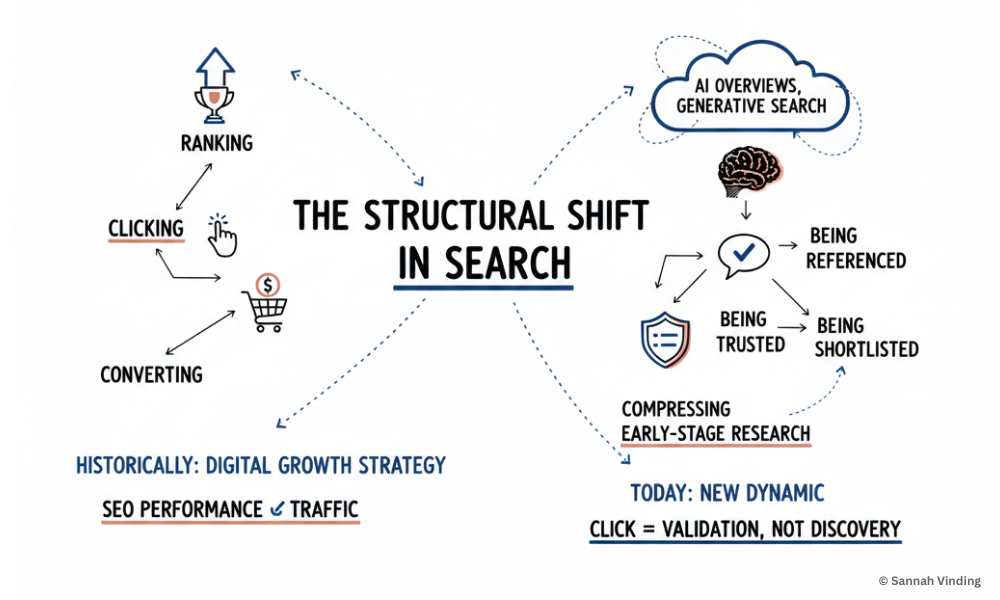
Historically, digital growth strategy was based on a predictable sequence:
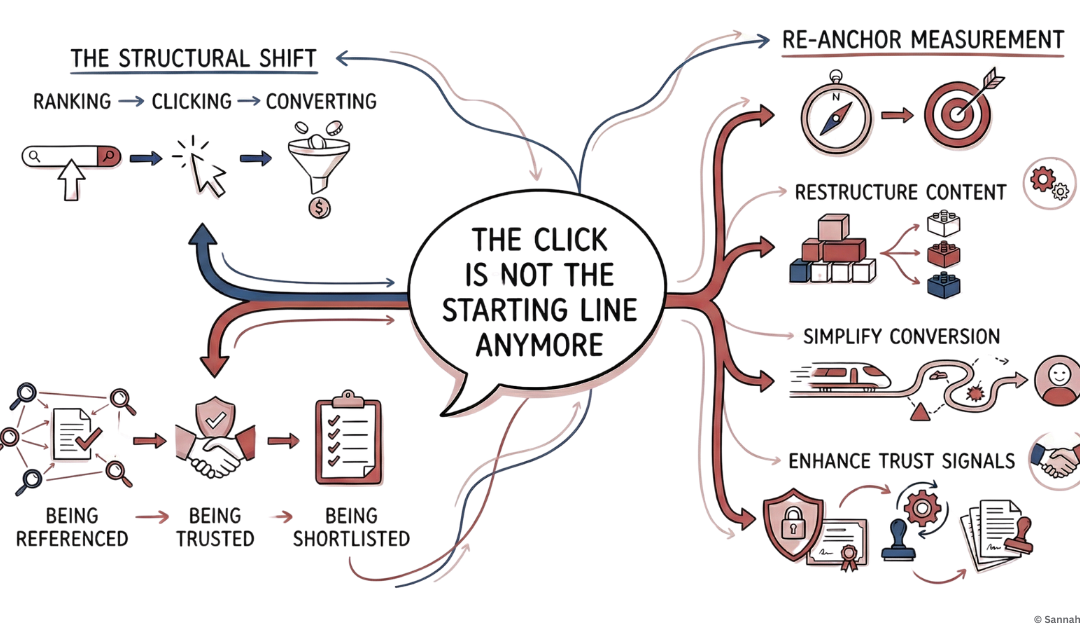
Ranking → Clicking → Converting
SEO performance correlated directly with traffic growth.
Today, search engines increasingly resolve informational intent without referral traffic.
AI overviews, generative search responses, and conversational interfaces are compressing early-stage research.
This introduces a new dynamic:
Being referenced → Being trusted → Being shortlisted
The click now often represents validation, not discovery.
2. Why industrial sectors are disproportionately affected
Technical B2B industries are uniquely exposed because:
-
-
- Websites contain structured product data.
- Pages include specification-rich content.
- Application notes provide detailed explanatory material.
- Datasheets train language models.
-
This depth improves AI accuracy.
It also reduces the necessity of clicking through for basic information.
Paradoxically, the better your technical content, the easier it is for AI to answer without sending traffic.
3. Interpreting traffic declines correctly
A decline in organic traffic does not automatically signal loss of opportunity.
In many cases, it signals filtration.
When informational queries are resolved in-platform, what remains are:
-
-
- Consideration-stage researchers
- Application-specific evaluators
- Decision-stage buyers
-
These visitors exhibit:
-
-
- Higher engagement depth
- Lower bounce rates
- Stronger conversion rates
-
The critical diagnostic is conversion quality, not session volume.
AI Overviews reduce click-through rates.
In 2025, queries that trigger AI Overviews show materially lower organic click-through rates compared to traditional search results. When answers are generated directly on the results page, fewer users click through to external websites.
source: searchengineland.com
4. The emerging priority: Conversion Rate Optimization
If visitor volume is structurally constrained, leverage must come from performance per visitor.
CRO in industrial B2B extends beyond A/B testing.
It requires coordinated alignment across:
-
-
- Intent-based SEO targeting
- Funnel-specific content architecture
- UX simplification and friction removal
- Analytics configuration
- Sales feedback integration
-
The organizations that win will not be those who restore volume.
They will be those who maximize qualified traffic.
5. Strategic actions for engineering-led organizations
A. Re-anchor measurement to business outcomes
Track:
-
-
- Sales-intent form completions
- RFQs
- Sample requests
- Technical inquiries
- Pipeline-influenced revenue
-
Traffic without pipeline impact is vanity.
B. Restructure content by funnel stage
Awareness content still matters.
However, investment should increase in:
-
-
- Application guides
- Comparison resources
- Technical validation assets
- Decision-support tools
-
AI absorbs awareness queries first.
Decision-stage intent remains click-driven.
C. Simplify conversion architecture
Common friction points in industrial websites:
-
-
- Multiple CTAs competing on one page
- Excessive form fields
- Slow page performance
- Weak proof signals
-
Each second of delay or unnecessary step increases abandonment probability.
D. Enhance trust signals
Industrial buyers prioritize risk reduction.
Integrate:
-
-
- Certification badges
- Compliance standards
- Case evidence
- Engineering validation
- Clear support pathways
-
Trust is the currency of shortlist inclusion.
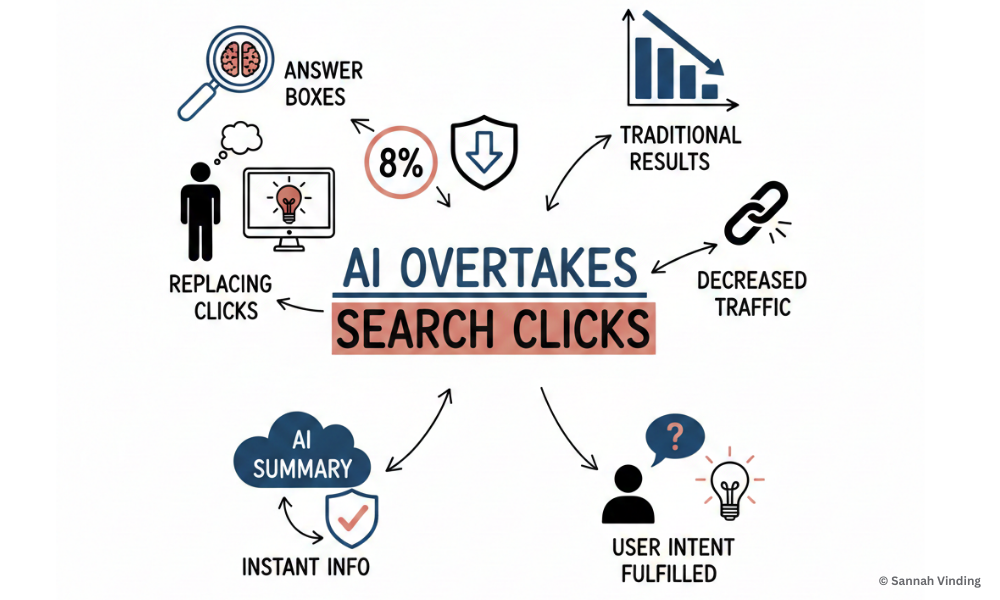
Only ~8% of users click traditional search results when an AI summary appears, suggesting that answer boxes are replacing clicks
source: semrush
6. Organizational implications
This shift requires marketing and sales alignment.
Marketing must:
-
-
- Focus on quality of visitor behavior
- Measure downstream performance
- Optimize conversion pathways
-
Sales must:
-
-
- Provide insight on lead readiness
- Share feedback loops
- Recognize that research is happening earlier and invisibly
-
The boundary between discovery and sales engagement is dissolving.
“AI is filtering early curiosity. What reaches your website now is closer to intent. That shifts the responsibility from traffic generation to conversion precision.”
— Sannah Vinding
Visibility Has Changed. Execution Must Too
Industrial search is transitioning from a click economy to a credibility economy.
AI systems filter early intent.
Search platforms answer before they refer.
Buyers arrive later, but more prepared.
The companies that adapt will:
-
-
- Optimize for referenceability
- Strengthen decision-stage content
- Improve conversion mechanics
- Align metrics directly to revenue impact
-
The critical question for leadership is no longer:
“How do we increase traffic?”
It is:
“When buyers form a shortlist, are we structurally positioned to be included?”
Because increasingly, the shortlist forms before the click.
And the companies that win will be the ones who designed for that reality first.

Sannah Vinding
Engineer and Go-To-Market Leader
I’m an engineer and go-to-market leader with global experience across electronics and semiconductor businesses. I work at the intersection of product, engineering, and marketing, translating technical detail into clear positioning, usable content, and GTM systems that teams actually use. My focus is on practical execution, product clarity, and applying AI where it removes friction rather than adding noise.
If this resonated, read these next
I Fixed My Bedsheets With AI. Then I Realized Our Buyer Journey Is Broken
I fixed my bedsheets with AI and realized what’s broken in the B2B buyer journey. How engineers now learn, evaluate, and decide.
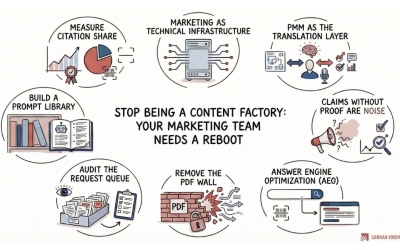
Stop Being a Content Factory: Your Marketing Team Needs a Reboot
Marketing in electronics is no longer about content volume. Learn why Product Marketing must map claims to proof and why machine-readable data now determines visibility with engineers and AI.
Follow for engineering-driven insight on AI, go-to-market strategy, and B2B growth in complex technical industries.