
Go-To-Market Fails When It Ignores Engineering Reality
Most go-to-market (GTM) structures used in electronics were borrowed from software playbooks.
That sounds harmless until you look at how technical buying actually works.
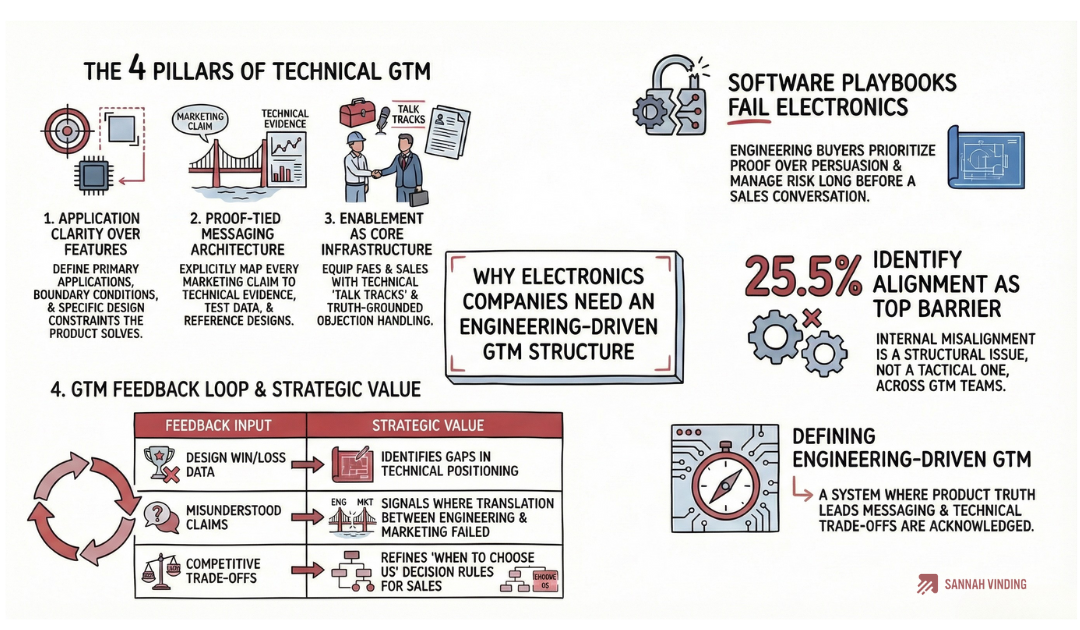
In electronics and manufacturing, engineers evaluate first, risk is managed early, proof matters more than persuasion, and design-in decisions can lock in revenue for years. Distribution and FAEs influence consideration long before a sales conversation happens. If your GTM structure is built around campaigns and short-cycle pipeline assumptions, the organization will feel misaligned even if everyone is working hard.
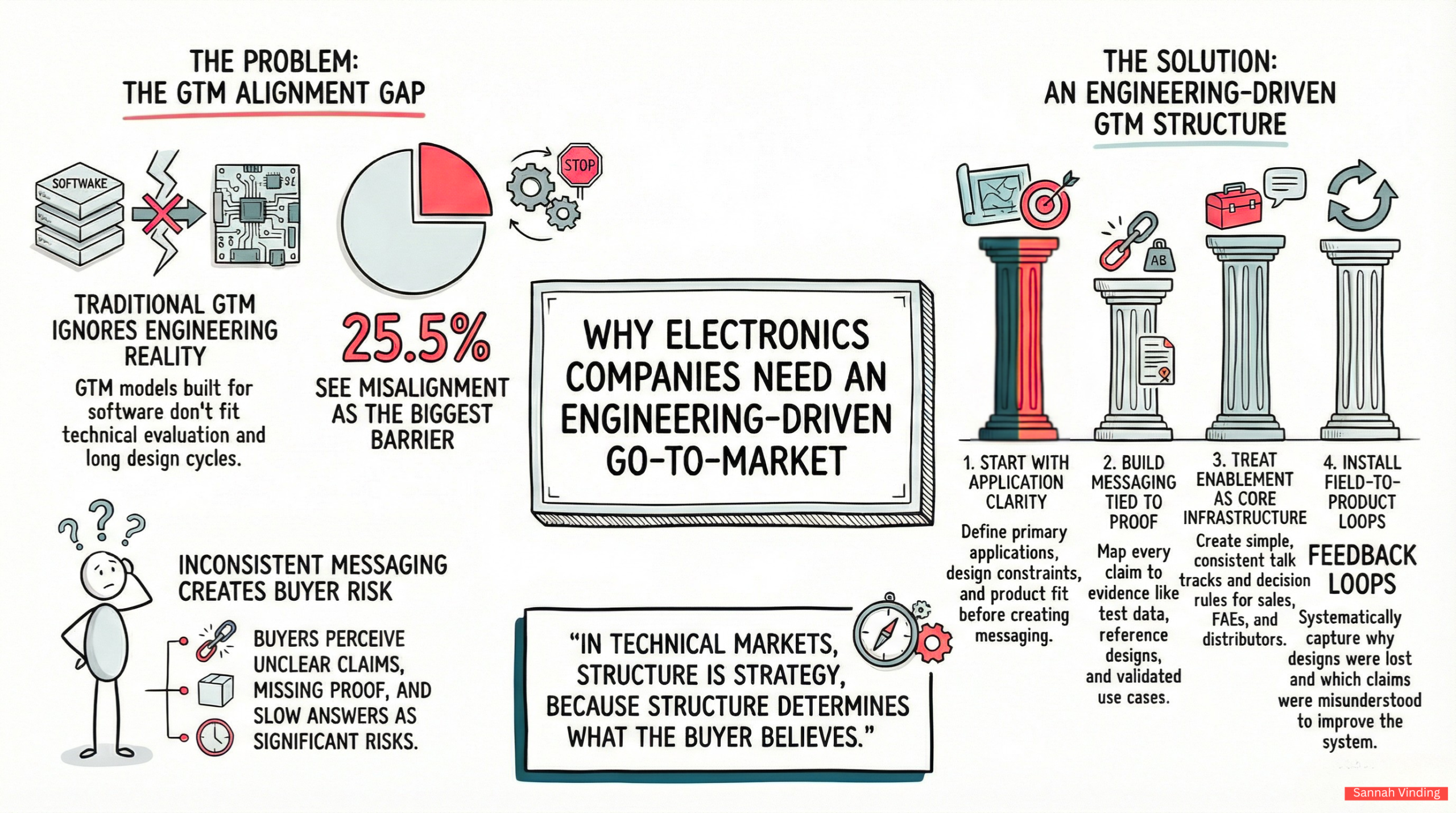
Go-to-market breaks down when structure is built around campaigns instead of how engineers actually evaluate risk.
A signal from 2025 that still defines GTM challenges in 2026
As we move into 2026, one data point from 2025 remains highly relevant.
A 2025 survey of go-to-market professionals found that 25.5 percent identified internal alignment as the single biggest barrier to GTM success. This clearly points to a structural issue, not a tactical one. The challenge is not a lack of content, tools, or activity. It is how organizations coordinate decisions, ownership, and execution across product, marketing, sales, and distribution.
For electronics organizations, this problem is amplified. Product truth is nuanced, trade-off driven, and tightly bound to application context. Messaging that is “close enough” may pass in other industries, but it breaks down quickly in engineering evaluation. When alignment is weak, credibility erodes early, long before sales has a chance to engage.
What “engineering-driven GTM” means
Engineering-driven does not mean engineering runs marketing.
It means the GTM system is designed around engineering reality:
-
-
- Product truth leads messaging, not the other way around
- Technical trade-offs are acknowledged, not hidden
- Proof and validation are built into the GTM plan
- Marketing translates and structures knowledge so buyers can evaluate quickly
-
This creates credibility at the moment engineers form initial preferences.
In electronics, credibility is established before sales is involved. GTM must earn trust early or it never recovers
The GTM structure that fits technical buying journeys
1) Start with application clarity, not feature lists
Before you write positioning, your org needs a shared understanding of:
- Primary applications and boundary conditions
- The design constraints the product solves
- Where the product wins and where it is not a fit
This prevents messaging from becoming generic and reduces rework.
2) Build messaging architecture tied to proof
Technical markets require an explicit mapping from claim to evidence:
- Test data, typical performance curves, and limitations
- Reference designs and validated use cases
- Reliability, qualification expectations, and lifecycle details
- Competitive trade-offs engineers already know exist
When this is documented, marketing, sales, FAEs, and distribution stop improvising.
3) Treat enablement as core infrastructure
If your FAEs and sales teams cannot explain the product value clearly in two minutes, the GTM structure is incomplete.
Enablement should include:
- Talk tracks by application and persona
- Objection handling grounded in technical truth
- Simple “when to choose us” decision rules
- Distributor-ready assets that remain consistent over time
4) Install field-to-product feedback loops
GTM becomes durable when the organization can learn:
- Why designs were lost
- Which claims were misunderstood
- Which competitors are being compared and why
- Which content is missing at evaluation time
This is what turns GTM into a system, not a set of launch activities.
“Alignment is not a marketing problem. It is an organizational design problem.”
Why this matters now
In 2026, technical buying is even more self-directed than it was a few years ago. Engineers and technical teams form preferences earlier, often before a supplier ever gets a live conversation.
That shifts the pressure onto your structure.
If your organization cannot move product truth consistently from engineering to marketing to sales, the market sees the gaps as risk: unclear claims, inconsistent messaging, missing proof, and slow answers.
This is why alignment keeps showing up as a top GTM challenge. It is not because teams do not care. It is because many GTM structures were not designed for technical evaluation, long design cycles, and multi-channel influence through FAEs and distribution.
When structure fits the buying reality, execution gets easier. When it does not, even strong teams feel stuck.
What leaders should do next
If you lead a technical organization, you do not need a full reorg to make progress. Start by tightening the system where truth often gets lost.
1) Define “product truth” in one place
Pick a single owner for a living source of truth that includes:
-
-
- Applications and boundary conditions
- Differentiation, including trade-offs
- Proof mapping (data, reference designs, qualification notes)
- “Not a fit” guidance
-
2) Make translation a formal responsibility
Product marketing should not be a content request queue. Assign accountability for:
-
-
- Positioning by persona
- Claim-to-proof mapping
- Messaging consistency across web, sales, FAEs, and distributors
-
3) Standardize enablement that matches real conversations
Stop shipping assets that require interpretation. Build:
-
-
- 2-minute talk tracks by application
- Objection handling grounded in technical truth
- Simple decision rules for “when to choose us”
- Distributor-ready packaging that stays consistent over time
-
4) Install feedback loops that change the system, not just the slide deck
Capture and review:
-
-
- Why designs were lost
- Where messaging was misunderstood
- Which competitors show up in evaluations
- Which proof was missing at evaluation time
-
The goal is not more activity. It is less drift.
In technical markets, structure is strategy, because structure determines what the buyer believes
Alignment does not improve because people try harder. It improves when clarity is built into how the organization operates.
In electronics, that clarity has to start with engineering reality: applications, trade-offs, and proof. When truth moves cleanly through the organization, trust becomes easier to earn.

Sannah Vinding
Engineer and B2B Marketing Strategist
I’m an engineer with global experience across electronics product development and go-to-market leadership. My work focuses on aligning engineering reality, marketing structure, and modern AI tools so technical organizations can communicate clearly and execute with confidence.
Follow for engineering-driven insight on AI, go-to-market strategy, and B2B growth in complex technical industries.