
AEO PUTS YOU ON THE SHORTLIST. THE LAST MILE WINS THE DEAL
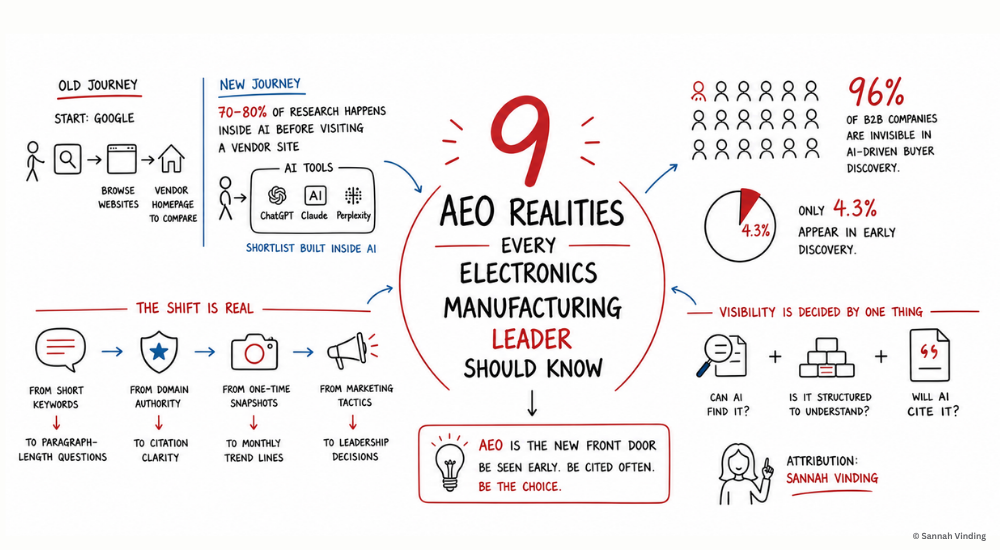
The technical buyer who used to start at Google now starts inside ChatGPT. They run the same vendor question across Claude, Perplexity, and Gemini. They compare answers. They build a shortlist. By the time they land on your website, that shortlist is already closed.
Most electronics and manufacturing companies have never seen the answers their buyers are reading. They do not know which competitors get cited. They do not know which questions return their name and which return silence.
The data is unforgiving. According to the 2X AI Innovation Lab’s 2026 AI Visibility Index, 96% of B2B companies are effectively invisible in AI-driven buyer discovery. Only 4.3% appear in the early-stage buyer questions where shortlists actually form.
For electronics and manufacturing leaders, this is the most important visibility shift in twenty years. It is also the most underestimated.
96% of B2B companies are effectively invisible in AI-driven buyer discovery. Only 4.3% appear in the early-stage buyer questions where shortlists are formed.
Source: 2X AI Innovation Lab, 2026 AI Visibility Index
Two things have changed at once
B2B buyers moved their research inside large language models faster than anyone predicted. G2’s March 2026 Answer Economy report found 51% of B2B buyers now begin research with an AI chatbot rather than Google, up from 29% in April 2025. The same study found 69% chose a different vendor than they originally planned based on what an AI chatbot recommended.
At the same time, our industry has gone from AI-curious to AI-default. NTT DATA’s 2026 Global AI Report on Manufacturing found 97% of manufacturing leaders say AI is already embedded in core manufacturing and supply chain workflows. AI is not a procurement experiment. It is the procurement workflow.
That means the engineers, FAEs, and sourcing teams making your buying decisions are inside AI tools every day. The question is whether you are visible to them when they ask.
And the buyer is not always a human anymore. AI agents are starting to handle research, comparison, and even shortlisting on the buyer’s behalf, making AEO more urgent, not less.
Here are nine realities every electronics and manufacturing leader needs to understand right now.
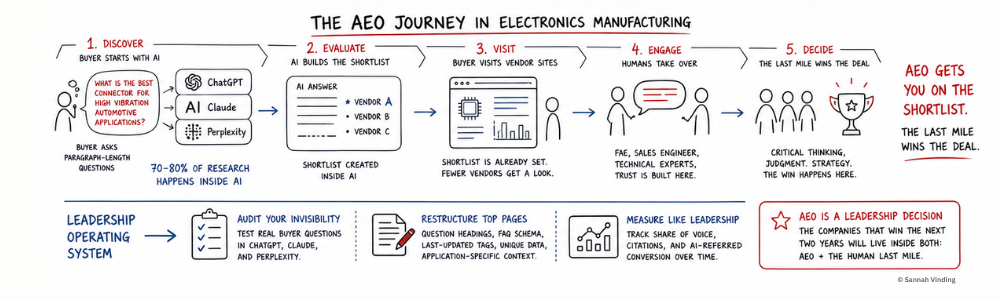
“AEO gets you onto the shortlist. The last mile is still human, and that is where the deal gets won. AI handles discovery. People close the loop. Both matter. Most companies are working on neither.”
Sannah Vinding
1. Your buyer’s first stop is no longer your website.
B2B buyers now complete 70 to 80% of their research before contacting sales (Forrester 2025 B2B Buying Study), and most of that research now happens inside AI tools. Engineering and R&D show the most diverse cross-LLM usage of any function in G2’s research, with Claude reaching its highest share among technical roles. They are asking, comparing, and deciding before you know they exist.
2. Most of our industry is invisible at the moment that matters.
The 2X AI Innovation Lab analyzed 70 B2B companies across discovery, evaluation, and purchase-stage queries. 96% surfaced only in late-stage queries where the buyer already knew the brand. Only 4.3% maintained a healthy presence in early discovery. For electronics and manufacturing companies, this means the competitors who do show up early are quietly building the shortlist without you. You will only find out when win rates start dropping.
AI adoption in manufacturing is not a technology deployment problem. It is a management behavior problem. The Gallup data makes that clear: employees with managers who actively support AI use are more than twice as likely to use it frequently. The tool is not the barrier. The model is.
Sannah Vinding
3. Engineers ask paragraphs, not keywords.
WebFX’s analysis of 20,000 ChatGPT conversations found the average opening prompt runs around 103 words, more than 20 times longer than a typical 5-word Google search query. Engineers do not type two-word keywords. They write paragraphs about an application, a thermal envelope, and a qualification standard. Generic content cannot match that input. Application-specific, context-rich content can. If your pages are still organized around short-tail keywords, you are writing for a search behavior that no longer drives technical buying.
4. Structure decides whether AI can use your content.
HubSpot’s analysis of 14 million AI citations found blog posts and listicles account for 62.1% of all citations. The pages that get cited share a pattern: question-based headings, FAQ schema, last-updated tags, embedded statistics, and clear answers. If your content reads like a brochure, models cannot extract it. If it reads like a sourced answer, models pull from it. Format is functional, not cosmetic.
5. Recency is the new authority signal.
ConvertMate’s 2026 AI Visibility Study, which analyzed more than 10,000 domains, found that 76.4% of ChatGPT’s most-cited pages were updated in the last 30 days, and content refreshed within the last 30 days earns 3.2 times more AI citations than older content. AI prefers fresh information because old information is often wrong. For electronics companies sitting on outdated technical content, the takeaway is clear. Refresh, restate, and republish on a monthly cadence, or watch the citations go to competitors that do.
6. Backlinks built SEO. They do not build AEO.
For thirty years, SEO ran on backlinks. AEO does not. Some of the most-cited pages in AI answers have minimal link authority. Models are not asking “how authoritative is this domain.” They are asking “does this paragraph answer the question.” For smaller electronics companies, this is rare good news. The playing field is more level than it has been in a generation.
“B2B buyers now complete most of their research before they ever contact you, and most of that research is happening inside AI tools. By the time the form gets filled out, the shortlist is closed. You are either on it or you are not.”
Sannah Vinding
7. Engineers form trust through consensus, not domain authority.
55% of AI citations for product comparison and recommendation queries go to LinkedIn, Reddit, and YouTube. Models cross-check claims against community discussion. If your engineers are not posting on LinkedIn, your customer stories are not on YouTube, and your products are never discussed in technical forums, the model has nowhere to confirm what your own site says. Visibility now lives in places most electronics marketing budgets still treat as optional.
8. Your application content is the AEO advantage most companies waste.
Datasheets, application notes, reference designs, and selection guides are the most credible technical content engineers consume. They are also the most underused AEO asset in our industry. Most companies still gate them behind forms, hide them in PDFs, or scatter them across distribution channels with no consistent metadata. Crawlable, contextual, structured technical content is your single biggest AEO opportunity. Locked PDFs are invisible to AI.
9. Stop measuring AEO like SEO. Start measuring it like leadership.
AI’s source list churns constantly. About half of the pages cited this month will not be cited next month, and only about 30% of brand mentions stay stable from one AI answer to the next. Snapshots are noise. What matters, as SpyFu and others have argued, is share of voice in AI answers, citation frequency over time, brand mention trends, and whether AI-referred traffic actually converts. Most marketing leaders are still tracking rankings and clicks. The teams that win the next two years teach their leadership to read AEO trend lines, not Google traffic charts.
The last mile is human. Always will be.
Here is what AEO data does not tell you. AI now runs the front of the buying journey. It handles the research, the summarization, the early comparison, the shortlist. It is getting good at the middle too, the validation, the cross-check. But the last mile is human. Always has been. Always will be.
The last mile is the moment your buyer finally talks to your team. It is the FAE on the call answering a hard application question. It is the engineer demonstrating judgment in a technical review. It is the sales engineer reading the room and adjusting. It is critical thinking, strategy, and trust, the things AI cannot fake and cannot replace.
AEO is how you get onto the shortlist. The last mile is how you win it. AI handles discovery. Humans close the loop. Strong AEO and a weak last mile means AI puts you in front of the right buyer and your team loses the conversation. Strong last mile and weak AEO means you never get in front of that buyer at all. Most companies in our industry are working on neither.
What leaders must do next
The work over the next 90 days is not glamorous. It is structural.
First, audit your invisibility. Pick ten questions an engineer or sourcing buyer would ask before evaluating a supplier in your category. Ask them in ChatGPT, Claude, and Perplexity. Note who appears, what gets cited, and whether your name shows up at all. If you cannot find yourself, you have your roadmap.
Second, restructure your most important pages. Convert headings to questions, add FAQ schema, add last-updated tags, embed unique data, and replace generic copy with application-specific context. Start with the five pages that carry the most commercial weight.
Third, decide what your leadership team will measure. Pick three AEO metrics and track them monthly: share of voice in AI answers, citation count, and AI-referred conversion rate. Stop reporting AEO performance as a single snapshot. Start reporting it as a trend.
These three moves are not a marketing initiative. They are the new operating discipline for every electronics and manufacturing GTM team that wants to be on the shortlist in 2027.
AEO is not the next tactic. It is the next operating system. AEO puts you on the shortlist. The last mile is still human, and that is where the deal gets won. The companies that win the next two years will learn to live inside both.
AEO IS A LEADERSHIP DECISION
The AEO gap in electronics and manufacturing is not between companies that have content and those that do not. It is between leaders who treat AEO as an operating discipline and those who treat it as a marketing tactic. The last mile is still human, and that is where the deal gets won.

Sannah Vinding
Engineer and Go-To-Market Leader
I’m an engineer and go-to-market leader with global experience across electronics and semiconductor businesses. I work at the intersection of product, engineering, and marketing, translating technical detail into clear positioning, usable content, and GTM systems that teams actually use. My focus is on practical execution, product clarity, and applying AI where it removes friction rather than adding noise.
If this resonated, read these next
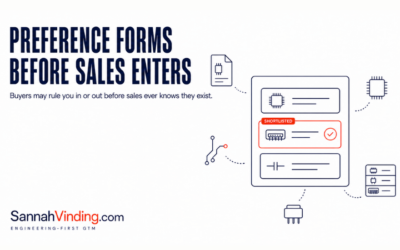
Preference Forms Before Sales Is Invited
AI is changing when technical buyers form preferences. Sales still matters, but buyers may compare, shortlist, and trust suppliers before the first conversation.
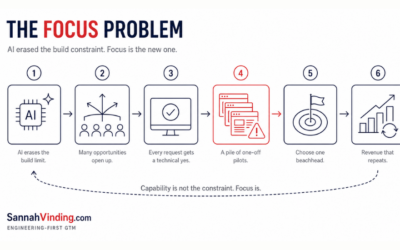
The Focus Problem: Why Electronics B2B Companies Stall After AI
AI removed the build constraint in electronics. Now focus decides which
B2B tech companies and manufacturers turn capability into repeatable revenue and
growth.
Follow for engineering-driven insight on AI, go-to-market strategy, and B2B growth in complex technical industries.