
The AI Adoption Gap in Manufacturing Isn’t a Technology Problem
One quarter of your workforce is using AI several times a week. Nearly half report no AI involvement in their role at all. And the gap between your leadership team and your engineers on the floor has not narrowed since Q2 2023. It has widened.
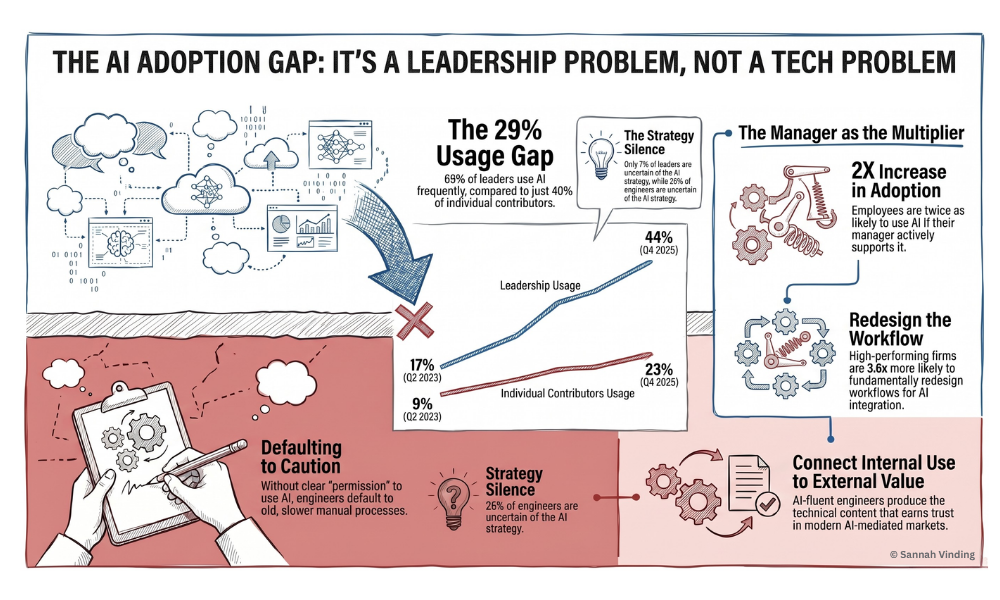
Gallup’s Q4 2025 workplace data puts numbers to something most manufacturing and electronics leaders can feel but have not yet named. Sixty-nine percent of leaders now use AI at some frequency. Individual contributors sit at 40%. That is not a skills gap. It is not a tool access gap. It is a communication and management gap, growing at exactly the layer of your organization where technical decisions get made.
Engineers are the ones qualifying components, designing power stages, selecting semiconductors. If AI is going to change how your organization moves from concept to production, it has to reach them. Gallup’s data says, in most manufacturing companies, it has not.
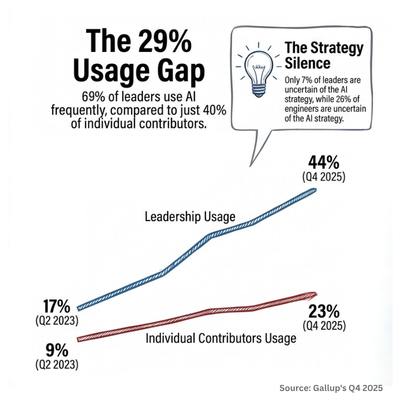
Leaders use AI at any frequency: 69%. Individual contributors: 40%. That gap has widened since Q2 2023, not narrowed.
source: Gallup, Q4 2025
Why the Gap Has Grown Instead of Closed
The headline from Gallup’s most recent workplace survey is that frequent AI use, defined as at least a few times a week, rose to 26% of employed adults by Q4 2025, with daily use climbing to 12%. On the surface, this looks like steady progress. The reality underneath is more complicated.
Manufacturing’s total AI adoption sits at approximately 43%, compared to 77% in technology. That sector gap has been discussed before. The more instructive number is the one inside the organization. Since Q2 2023, frequent AI use among leaders has risen from 17% to 44%. Among individual contributors over the same period, it went from 9% to 23%. Leaders have more than doubled their frequency. Individual contributors have not kept pace.
The reason is not that frontline workers are less capable of using AI. It is that most of them have never been clearly told how. Only one in four employees say their employer has clearly communicated how AI is supposed to be used in their work. And 26% of individual contributors report being uncertain about their company’s AI strategy at all, compared to just 7% of leaders. Leaders know the strategy because they wrote it. Everyone else is guessing.
This is not a deployment problem. It is a leadership model problem.
The Manager Is the Multiplier
Gallup’s data includes a finding that should be on the desk of every VP of Engineering and every marketing leader in electronics: employees who strongly agree their manager actively supports AI use are more than twice as likely to use it frequently. Not somewhat more likely. More than twice.
This means that AI adoption at the floor level, where engineering work actually happens, is a management behavior before it is a technology rollout. The companies gaining ground in manufacturing are not the ones with the best AI tools. They are the ones where the direct manager has made AI use a visible, expected, and supported part of the team’s normal workflow.
What does that look like in practice? It looks like a manager who names specific tasks where AI is appropriate, reviews AI-assisted outputs with engineers, creates space to try and fail without penalty, and treats AI fluency as a professional development priority rather than a personal preference. When that behavior is present, adoption follows. When it is absent, engineers assume the default is still the old way.
In electronics and semiconductors specifically, this matters commercially. Engineers who are evaluating components, writing application notes, or interpreting datasheet specifications are performing tasks where AI can meaningfully reduce time and improve accuracy. The productivity gain is real. But only if the engineer has been given permission, guidance, and a clear model for what good use actually looks like at the workbench level.
AI adoption in manufacturing is not a technology deployment problem. It is a management behavior problem. The Gallup data makes that clear: employees with managers who actively support AI use are more than twice as likely to use it frequently. The tool is not the barrier. The model is.
Sannah Vinding
The Communication Gap Has a Cost
The number that deserves more attention than it has received: 26% of individual contributors say they are uncertain about their company’s AI strategy. One in four engineers at the floor level does not know what leadership intends.
That uncertainty has a cost. An engineer who does not know whether AI-assisted outputs are acceptable, reviewed, or trusted will default to not using them. Especially in highly regulated or quality-sensitive environments like aerospace-grade electronics, medical devices, or automotive power systems, the default under ambiguity is caution. That caution is rational at the individual level. But it compounds across an organization and becomes a structural drag that no tool purchase can fix.
McKinsey’s State of AI 2025 report adds a useful contrast. High-performing organizations are 3.6 times more likely than average firms to fundamentally redesign workflows when deploying AI, with 55% doing so versus roughly 20% for others. The distinction between high and average performers is not which AI tools they use. It is whether leadership has built the organizational conditions for AI to operate inside existing work, not alongside it.
Most manufacturing companies have done the alongside version. The tools are available. The training may have happened. But the workflow redesign, the part where someone in a leadership position says “this is how we do this now,” has not followed. And so the tools sit at the leadership layer, and the floor keeps working the old way.
Visibility Follows the Same Pattern
There is a direct connection between this internal adoption gap and how manufacturing companies show up externally to engineers and procurement teams.
If your engineers are not yet using AI confidently in their own workflows, they are unlikely to be producing the kind of application-level content, technical documentation, and structured product information that AI systems use to surface your products to buyers. Your external visibility in AI-mediated search depends on whether your internal experts can articulate and structure what they know, in a form that is clear, specific, and trustworthy enough to be cited.
A company where individual contributors, the engineers with the deepest product knowledge, have been brought into AI adoption, not just the leaders, is a company capable of generating technical content that earns trust before a buyer ever contacts sales. The internal adoption gap and the external visibility problem are the same problem, seen from different angles. Solving one accelerates the other.
What Leaders Must Do Next
The Gallup data points to three specific actions that move the needle, and they all start with leadership behavior rather than technology investment.
First, make the AI strategy legible at every level. A strategy document from an executive offsite is not communication. Communication means your engineers know which tasks AI is appropriate for, what standards apply to AI-assisted work, and what the team is learning together. If 26% of your individual contributors are uncertain, the message has not reached the floor.
Second, treat the direct manager as the unit of adoption. Gallup’s data is clear: manager behavior is the single strongest predictor of frontline AI use outside of technical integration itself. AI adoption programs that skip the manager layer will not deliver floor-level results. The manager has to champion it, model it, and make it normal.
Third, connect internal adoption to external outcomes. The engineers who learn to use AI well in their own work are the same people who can generate the structured, authoritative technical content that makes your products visible and credible in an AI-mediated market. This is not a side benefit. It is a compounding return on the same investment.
AI Adoption Is a Leadership Decision
The AI gap in manufacturing is not between companies that have AI and companies that do not. It is between leaders who understand that adoption is a management responsibility and those who believe the tool is enough.

Sannah Vinding
Engineer and Go-To-Market Leader
I’m an engineer and go-to-market leader with global experience across electronics and semiconductor businesses. I work at the intersection of product, engineering, and marketing, translating technical detail into clear positioning, usable content, and GTM systems that teams actually use. My focus is on practical execution, product clarity, and applying AI where it removes friction rather than adding noise.
If this resonated, read these next
Preference Forms Before Sales Is Invited
AI is changing when technical buyers form preferences. Sales still matters, but buyers may compare, shortlist, and trust suppliers before the first conversation.
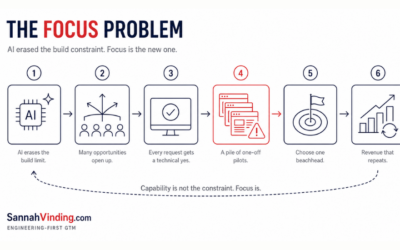
The Focus Problem: Why Electronics B2B Companies Stall After AI
AI removed the build constraint in electronics. Now focus decides which
B2B tech companies and manufacturers turn capability into repeatable revenue and
growth.
Follow for engineering-driven insight on AI, go-to-market strategy, and B2B growth in complex technical industries.