
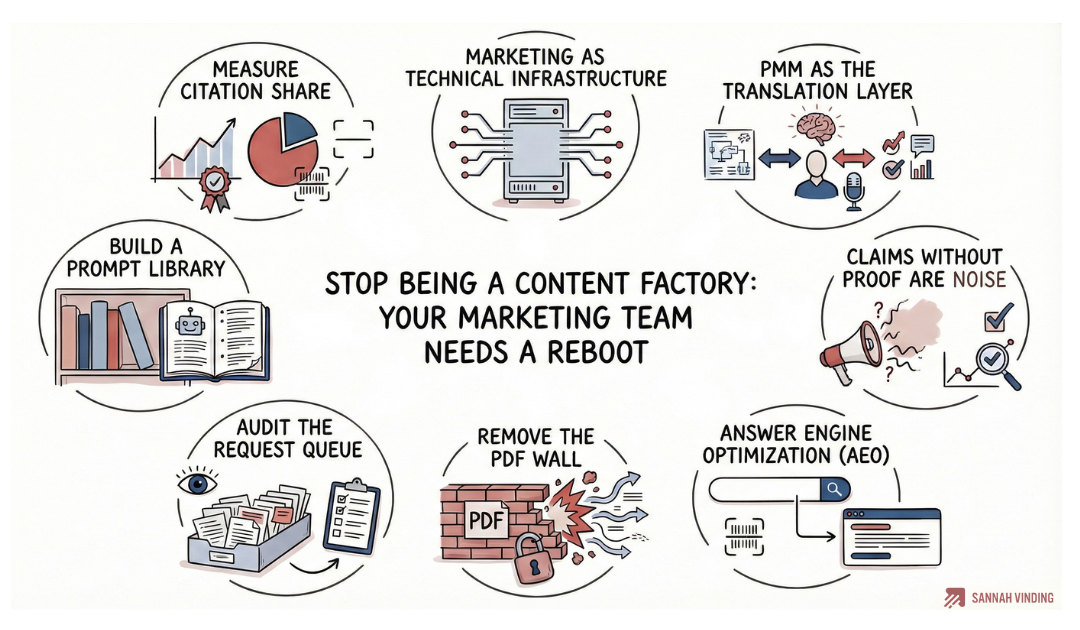
Marketing Is No Longer a Creative Service It Is Technical Infrastructure
This Is Not a Content Problem It’s an Operating Model Problem
If your Product Marketing Managers spend their days fulfilling internal requests for “snazzy brochures,” and your team is still chasing keywords like “semiconductors,” you are running a 2018 playbook.
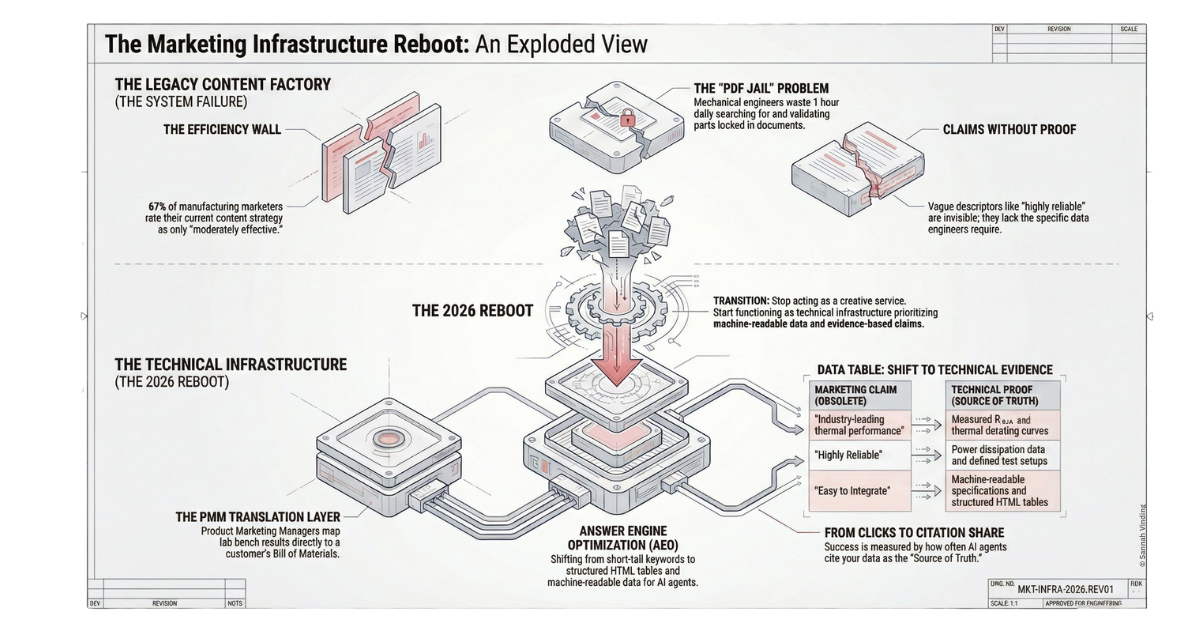
The industry is already hitting a wall. The Content Marketing Institute’s 2025 Manufacturing report found that 67% of manufacturing marketers rate their content strategy as only “moderately effective” at best.
This isn’t a tooling problem. It’s an operating model problem.
In electronics and hardware, the gap between engineering reality and market perception keeps growing. Teams respond by producing more content. More slides. More PDFs. More noise.
That is the wrong move. Marketing is no longer a creative service. It is technical infrastructure.
Product Marketing is the Translation Layer, Not a Content Queue
For years, PMMs have been treated as internal order-takers. Someone asks for a deck, a one-pager, or a launch email, and PMM executes.
That wastes the most expensive talent in the room.
In 2026, Product Marketing is the translation layer between a lab bench and a customer’s Bill of Materials. Their job is not to write copy. It is to make sure every claim survives contact with an engineer.
This shift is mandatory because the way engineers find you has changed. Recent research from EETech shows younger Millennial and Gen Z engineers start research in digital communities and search layers long before they ever talk to a vendor. And with roughly 60% of Google searches ending in “zero-click” results, most of that evaluation happens in answer engines, not on your gated product page.
Claims Without Proof Are Noise
Marketing loves phrases like “highly reliable.” In 2026, those claims are invisible. You need evidence that is immediate and accessible.
Claim: Industry-leading thermal performance.
Proof: Measured junction-to-ambient thermal resistance (RθJA), thermal derating curves, power dissipation data at defined airflow conditions, and the test setup used.
If that data is locked inside a PDF, you lose. TraceParts, citing a Siemens partner study, found that design engineers can spend over 1,000 hours per year searching for and validating parts. It’s a massive productivity drain. If you make the engineer or their AI agent work to find the proof, they’ll buy from someone else.
Engineers can spend over 1,000 hours a year just searching for and validating parts.
Marketing Owns the System, Not “Promotion”
Promotion is a relic.
Marketing today is about being the cited source when an AI agent answers a technical question. The TraceParts Leo AI announcement highlights a new pattern. Engineers are ditching manual catalog filtering for queries like: “Find me a ball bearing with a 25 mm inner diameter, lifespan of 10,000 cycles, and speed of 8,000 RPM.”
If your product data isn’t structured for these AI layers, you won’t be in the results.
Answer Engine Optimization (AEO) means:
-
-
- Structured data: Use clean HTML tables and schema markup.
- Context-rich answers: Stop writing for short-tail keywords.
- Machine readability: Build so AI can extract and recommend you accurately.
-
60% of Google searches now end without a single click.
AI Is a Co-Pilot, Not a Copywriter
If your team uses AI to write social posts, they are missing the point. In 2026, AI is a research partner for technical marketers.
But there is a trust gap. Data shows only 43% of developers feel good about AI accuracy, while 31% remain skeptical. They cross-check AI answers against technical documentation and sources.
Marketing must provide the “Source of Truth” that AI can cite to satisfy these skeptics. Use it to:
-
-
- Review competitor filings to find roadmap gaps.
- Compare your electrical, thermal, and environmental specifications against the market to identify real differentiation.
- Track patent filings to spot where the industry is headed before products launch.
-
“We spent years building content when we should have built data. If your specs aren’t machine-readable, your marketing is invisible.”
— Sannah Vinding
Four Strategic Plays for Engineering Marketing
| Action | What It Actually Means |
|---|---|
| Audit the queue | Kill request-driven work. If a task doesn’t map a claim to proof, stop doing it. |
| Remove the PDF wall | Move product specs to HTML tables that machines can index. |
| Build a prompt library | Standardize how you do competitive analysis so quality doesn’t vary by person. |
| Change the metric | Stop measuring clicks. Start measuring citation share. |
This Is a Rebuild, Not an Optimization
The electronics industry moves too fast for “pretty” marketing.
What works now is a system built on clean data, clear ownership, and evidence-based claims. Most teams fail at the first step: basic AI readability.
An AEO audit usually exposes that gap in under an hour. With 60% of searches ending without a click, if you aren’t machine-readable, you are invisible.

Sannah Vinding
Engineer and B2B Marketing Strategist
I’m an engineer with global experience across electronics product development and go-to-market leadership. My work focuses on aligning engineering reality, marketing structure, and modern AI tools so technical organizations can communicate clearly and execute with confidence.
If this resonated, read these next
Stop Copying SaaS Playbooks: The Engineering-Driven GTM Operating System for 2026
Why SaaS go-to-market models fail in electronics and what engineering-driven teams must build instead. A practical GTM operating model for AI-driven discovery, supply chain volatility, and trust in 2026.
How AI Fits Into Engineering-Driven GTM Without Breaking Trust
How electronics companies can use AI in go-to-market without losing trust. Learn where AI helps, where it hurts, and how structure protects credibility.
Follow for engineering-driven insight on AI, go-to-market strategy, and B2B growth in complex technical industries.