
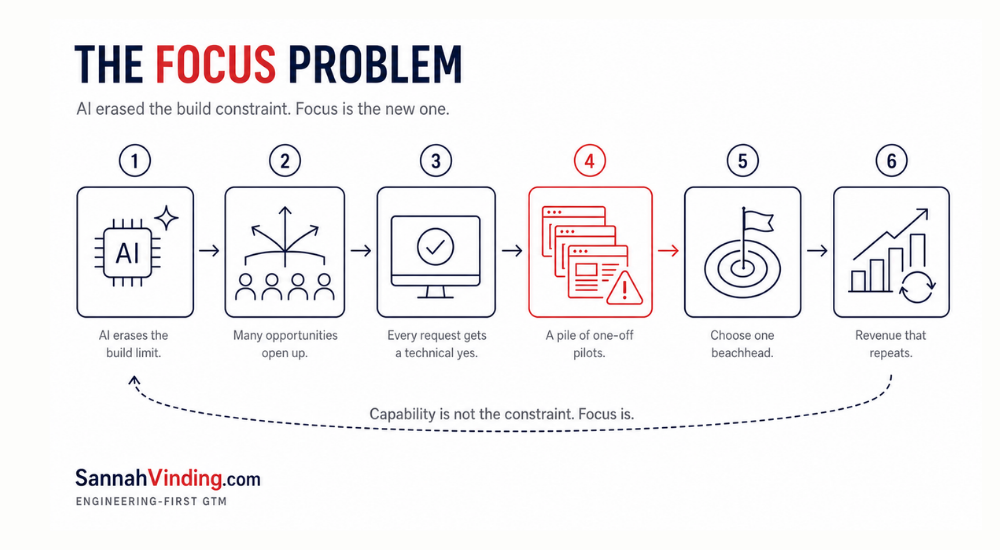
AI Erased the Build Constraint. Focus Is the New One.
For years, the hardest question in electronics was whether you could build the thing.
Could the parametric search return the right part. Could the component data be clean enough that an engineer would trust it. Could you ship the platform, the integration, the new product line at all.
AI has quietly erased that question.
A component-search startup can now serve engineers, reps, distributors, and manufacturers in the same week. A manufacturer can step into three adjacent categories. A software company built for the electronics channel can say yes to almost any request that comes in.
That sounds like progress.
It is also where a lot of companies stall.
When a company can do ten things, doing all ten feels like momentum. What it usually builds is a pile of one-off proofs. A demo here. A pilot there. A lot of interest, and no product anyone can sell the same way twice.
The constraint moved.
It used to be capability. Now it is focus. And most teams have not noticed the switch.
“Capability used to be what set you apart. AI handed it to everyone. The only edge left is deciding which buyer you are actually for.”
Sannah Vinding
Capability is not the hard part anymore
The shift happened fast, which is part of why it is easy to miss.
AI turned natural language into working component discovery, alternative-part matching, and document extraction that used to take a team of engineers to build. Platforms like CELUS and Z2Data now do in seconds what once justified a full roadmap.
The technical wall that used to separate serious companies from weekend projects got a lot lower.
When capability is common, it stops being the thing people pay for.
The failure data says this out loud. When CB Insights looked at why venture-backed companies shut down, the most common reason was poor product-market fit, at about 43 percent of cases (CB Insights).
These were not teams that could not build.
They built plenty. They aimed at the wrong thing, or at everything.
The build was never the part that decided it.
The trap has a name
In 2026, researchers at INSEAD studied 26 B2B tech founders. They found that companies stall “not in the technology they are peddling, but because founders underestimate the need to orchestrate a coherent growth system” (INSEAD Knowledge).
They named one of the traps the PoC plateau.
A steady flow of proofs of concept and awards that never turns into repeatable revenue.
This is not only a startup problem. In MIT’s 2025 study of enterprise AI, about 95 percent of generative AI pilots delivered no measurable return, even after tens of billions in spend (Forbes on MIT, 2025). The models mostly worked. The pilots just never became a repeatable part of the business.
About 95% of enterprise generative AI pilots delivered no measurable return in 2025, despite tens of billions invested. The technology mostly worked. The pilots never became a repeatable part of the business.
Source: MIT, State of AI in Business 2025
If you build for electronics, you have lived this.
A distributor asks if the platform can cross-reference their BOM. A manufacturer asks if it can surface their parts earlier. An enterprise team asks for a worst-case analysis workflow.
Each request gets a technical yes and a quick demo.
Interest grows. But the buyer, the scope, the price, and the repeatability stay fuzzy.
Six months later there are ten happy pilots and nothing that can be sold twice the same way.
The demos proved the technology works.
They said nothing about whether one clear buyer will pay for it on a schedule you can plan around.
In electronics, every buyer is a different company
This is the part that makes focus so hard here.
The electronics value chain is not one customer.
-
- An engineer wants to choose a part faster.
- A rep wants to answer a cross-reference and protect a design win.
- A distributor wants into the design conversation with price and availability.
- A manufacturer wants to be found earlier and see unmet demand.
From the outside, those look adjacent. They are not.
Each one is a different buyer, a different sales cycle, a different proof of value, and a very different willingness to pay.
A manufacturer weighing a new product category faces the same fork. The engineering may transfer cleanly. The route to market does not. A new category can mean a new buyer, a new channel relationship, and a demand motion the current sales team has never run.
Anyone who has worked the channel knows the deeper wrinkle. The party that creates the demand is often not the party that fulfills the order. A rep registers the design, an engineer selects the part, and the purchase flows through a distributor somewhere else entirely. Serving that world takes channel fluency, not just leads. A company that misses this builds for a buyer who does not actually control the outcome.
The question is never whether you can serve the segment.
It is which segment gets a product and a real go-to-market push first.
And which ones get a polite no for now.
This is why “we have a lot of interest” can be a warning sign, not a milestone.
Interest spread across four buyers is four half-built businesses.
Interest in one is the start of a real one.
Poor product-market fit is the single most common reason venture-backed companies shut down, at about 43% of cases. They did not fail to build. They failed to aim.
Source: CB Insights
Focus is what makes revenue repeat
Here is the part founders resist, and the market keeps proving it anyway.
Narrow wins.
Vertical software built for one industry grew about 31 percent in median recurring revenue in 2025, ahead of horizontal peers, and it tends to acquire customers far more cheaply, because it speaks to one buyer’s real problem instead of everyone’s general one (SaaS Mag, 2026).
Focus is not a smaller ambition.
It is the thing that makes revenue repeat.
The INSEAD research showed the same effect inside a single company. One founder stopped chasing every lead and concentrated on the verticals where his platform mattered most. His win/loss ratio doubled in nine months.
Nothing about the technology changed.
The aim did.
“Ten happy pilots is not traction. It is ten reasons to avoid the one decision that would turn your technology into a business.”
Sannah Vinding
The useful leadership question
The question is not “what else can we build.”
In an AI-mediated market, you can probably build most of it.
The better question is this. Which one opportunity deserves a product and a go-to-market motion right now, and are we willing to say no to the rest for a while.
That sits with leadership, not with the roadmap.
It is uncomfortable, because it means turning down good work. Real opportunities, with real people who want to buy. Saying no to those is what makes the one yes worth anything.
Three things help you answer it.
Separate capability from commercialization. A technical yes is not a market. Before you build the next thing, name the buyer, the offer, the price, and the proof that this segment will pay again and again.
Choose a beachhead on purpose. Put your opportunities side by side and score them the same way. Who is the buyer. How sharp is the pain. Does the product already fit. Can it repeat. Will they pay. Then pick one. The instinct is to pick the biggest market. That is usually the wrong move. Pick the one where you already have unfair access, a relationship, a proof, a channel that trusts you, because that is where a first real win is actually in reach. The question I keep coming back to is simple. Which opportunity would you regret not pursuing this quarter. The answer is rarely the largest one.
Protect the motion, not just the pipeline. A repeatable revenue engine needs an owner and a defined scope. Without an owner, the motion drifts back to whoever is loudest that week.
“In electronics, saying no to a good opportunity is not caution. It is how you earn the one yes that becomes a business.”
Sannah Vinding
Doing fewer things well is not caution.
Right now it is the only way to build something that compounds.
Capability is not the constraint anymore.
Focus is.
There is a second half to this
Once you decide which buyer you are for, the next question is whether they can find you at all.
In an AI-mediated market, buyers and AI build the shortlist before anyone picks up the phone. Focus decides who you are for. Visibility decides whether they ever see you.
That second half is the subject of my book, Visible or Invisible, coming this September.
FOCUS IS A LEADERSHIP DECISION
Growth in electronics is no longer decided by what your technology can do. It is decided by what you choose to commercialize first. Capability fills the room with demos. Focus turns one of them into a business.

Sannah Vinding
Engineer | Product Marketing & GTM Systems Leader
I am an engineer and go-to-market leader who has spent my career inside the electronics industry, across manufacturers, distributors, and reps, and in the messy space between a design win and a purchase.
Choosing which opportunity to commercialize first, and turning it into a go-to-market motion that repeats, is what I help electronics and technology companies do.
I do not stop at the diagnosis. I work with teams to turn the chosen focus into a plan and help run it, so the decision becomes a motion, not a memo.
If your company has more opportunities than focus, that is exactly the kind of conversation I like having.
If this resonated, read these next
AI Changes the Work Before It Changes the Job Title
AI is changing tasks, workflows, and decision points before job titles. For electronics supply-chain leaders, the last mile still needs human judgment.
Everyone Wants an Agentic AI Strategy. Few Have Mapped the Work.
Agentic AI will not fix unclear workflows. Leaders need to map how work actually gets done before adding AI agents to the process.
Follow for engineering-driven insight on AI, go-to-market strategy, and B2B growth in complex technical industries.