
AI Is Not Just a Tool Shift. It Is a Leadership Shift
AI conversations often jump straight to job titles.
Will AI replace this role?
Will this function need fewer people?
Will certain jobs disappear?
Those questions are understandable. They are usually the questions people ask first because job titles are visible. We know what a sales role is called. We know what an engineering role is called. We know what customer service, operations, marketing, or product management looks like on an org chart.
But I do not think the org chart is the best place to start.
The better question is:
Which parts of the work are already changing?
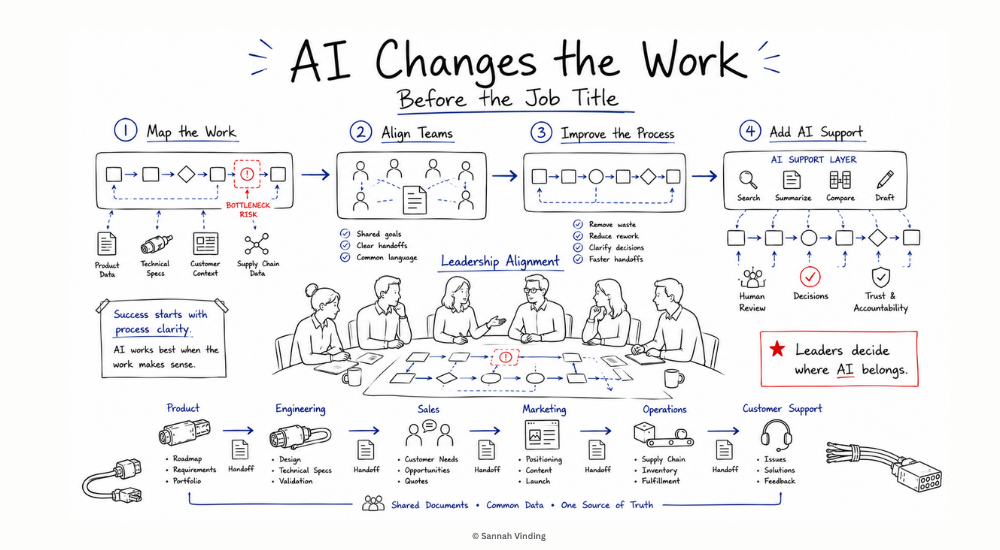
Before AI changes a job title, it changes a task. It changes a handoff. It changes how information is found, summarized, compared, routed, checked, and acted on.
That distinction matters, especially in the electronics supply chain.
This is not a simple work environment. Product data, availability, customer requirements, engineering trust, compliance, pricing, substitutions, lead times, supplier relationships, and internal handoffs all sit inside the same flow of work.
So when people talk about AI as if it is just a tool you drop into the business, I think we miss the bigger point.
AI can help with parts of that flow.
But it cannot own all of it.
That is where leaders need to pay attention.
66% of AI users said AI allows them to spend more time on high-value work.
AI adoption is moving faster than organizational readiness
The pressure to act is real.
Microsoft’s 2026 Work Trend Index is useful here because it moves the AI conversation past “people are trying tools” and into the bigger question of how work is being redesigned. In that research, 66% of AI users said AI allows them to spend more time on high-value work, and 58% said they are producing work they could not have produced a year ago.
That is not just a technology shift. That is a work-design shift.
But the same research also points to the part leaders cannot ignore: organizational conditions matter. Microsoft found that organizational factors such as culture, manager support, and talent practices account for 67% of reported AI impact, compared with 32% for individual mindset and behavior.
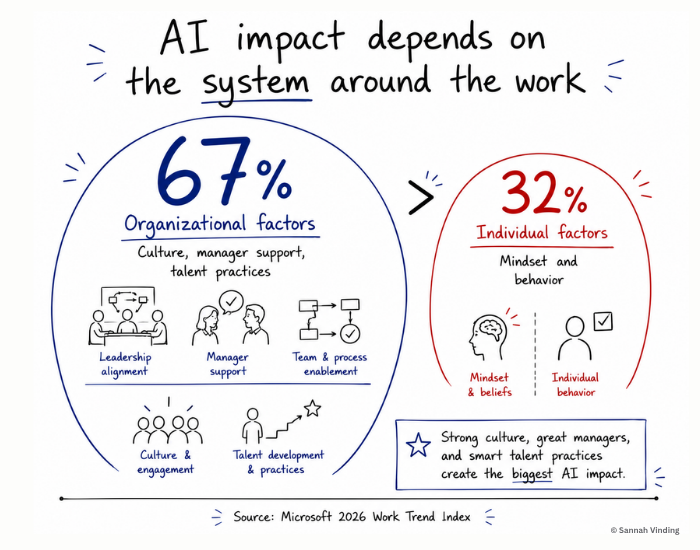
That is the gap I think many companies are going to feel.
People may be ready to use AI in parts of their day-to-day work, but the systems around them may not be ready yet. The process may not be clear. The data may not be clean. The manager may not know what good AI-supported work should look like. The team may not have agreed on where AI can help and where human judgment still needs to stay close.
The manufacturing and supply-chain world is not sitting on the sidelines either. PwC’s 2026 AI Jobs Barometer manufacturing analysis found that AI roles grew from 2.3% of total manufacturing job postings in 2024 to 3.7% in 2025. It also found that AI job postings in manufacturing grew 42.4% in 2025, while overall manufacturing job postings grew 3.8%.
That tells us something important. AI is not only showing up in software companies or generic office work. It is moving into manufacturing, operations, optimization, supply chain functions, and the systems around how work gets done.
And I understand why. There is a lot of potential here.
AI can make information easier to find. It can help teams move faster through repetitive work. It can support analysis, documentation, training, customer preparation, and internal communication. In the right places, that is useful.
But there is still a risk in moving too quickly from “AI is important” to “let’s put tools everywhere.”
AI does not automatically improve the work.
In many cases, it exposes where the work was unclear to begin with.
If the process is already messy, AI may not clean it up. It may just help the mess move faster.
That is not transformation.
That is acceleration without clarity.
“The real leadership question is not where we can add AI. It is where AI belongs in the flow of work, where it creates value, and where human judgment needs to stay close.”
Sannah Vinding
Start with the flow of work
My background in value stream mapping, process improvement, and optimization shapes how I look at AI adoption.
I do not start with the tool.
I start with the work.
The way I would look at it is pretty simple: follow the information. Where does it move? Where does it wait? Where does it get repeated? Where do handoffs break? Where do decisions slow down? Where does customer context get lost? Where does someone still need to make a judgment call?
Those questions may sound basic, but they are the questions that make AI practical.
Because AI is not equally useful everywhere.
Some tasks are good candidates for AI assistance. Some need human review. Some should not be automated at all. And some workflows need to be cleaned up before AI can add real value.
That last part is important.
If two teams do not agree on what “good” looks like today, AI is not going to magically create alignment. If product data is messy, AI may make it easier to surface the wrong thing. If customer information is scattered across systems, AI may summarize the fragments without understanding the relationship behind them.
This is why I think the leadership conversation needs to come before the tool conversation.
Not because tools do not matter. They do.
But the tool is only useful if the team understands where it belongs in the work.
AI changes the work before it changes the role.
Look at the tasks first: what is repetitive, slow, unclear, or risky? That is where the real AI conversation becomes more practical, and much more useful.
AI changes tasks first
In practical terms, AI is already changing work at the task level.
It may help one person summarize a long document before a meeting. It may help another person clean up notes after a customer call. It may help a sales team prepare account research, or a product team organize technical content, or an operations team look for patterns in exceptions and delays.
Those examples are not dramatic. They are not usually the things that make big headlines.
But they are where the work starts to shift.
A customer service role may still exist, but the way inquiries are triaged may change.
A sales role may still exist, but the way call notes, follow-ups, and account research are prepared may change.
A product or marketing role may still exist, but the way technical content is searched, organized, and repurposed may change.
An operations role may still exist, but the way patterns, exceptions, and bottlenecks are surfaced may change.
That is why I think the “will AI replace jobs?” question can become too broad too quickly.
When leaders only ask which roles AI will replace, the conversation becomes abstract and emotional. People naturally start protecting the title, the function, or the team.
When leaders ask which tasks are changing, the conversation becomes more useful.
It becomes possible to look at the work with more honesty:
What is repetitive?
What is slow?
What is frustrating?
What needs better information?
What needs a human decision?
What should never go out the door without review?
That is a different conversation.
AI changes the shape of the work before it changes the name of the role.
The electronics supply chain needs a more careful AI conversation
Generic AI advice does not always translate well into electronics.
A wrong product detail can create real problems. A bad substitution can damage trust. A hallucinated technical answer can create confusion for a customer or engineer. A compliance miss can have consequences.
A faster response is not helpful if it is inaccurate.
That is why the electronics supply chain needs a more grounded conversation about AI.
The question is not simply:
Can AI do this?
The better question is:
Where in the workflow can AI reduce friction without increasing risk?
That is a very different standard.
AI may be useful in helping a team summarize a customer inquiry, organize internal notes, or surface related product information. That kind of support can save time and make the first step easier.
But if the output involves a technical recommendation, a compliance-sensitive answer, a product substitution, or a customer-facing decision, the last mile still needs human judgment.
That is not a weakness of AI. It is the reality of technical work.
The more complex the product, the more context matters. The more trust matters. The more important it becomes to know when a fast answer is not enough.
AI can assist the process.
It should not quietly become the process owner.
Real-world examples show the opportunity
The opportunity is real when AI is applied to defined workflows.
Jabil, a global engineering, manufacturing, and supply-chain company, worked with AWS on AI-driven solutions for manufacturing operations. According to the AWS case study, Jabil saw a 74% decrease in data processing times, a 67% to 83% reduction in deployment times, and 23% cost savings through serverless integration. The company also built the first iteration of an intelligent shop-floor assistant in one week.
Jabil saw a 74% decrease in data processing times, a 67% to 83% reduction in deployment times, and 23% cost savings through serverless integration.
Source: aws.amazon
That example is useful because it shows AI being applied to specific work.
Not “AI will change everything.”
Not “AI will replace everyone.”
A defined process.
A clear use case.
A measurable outcome.
That is where AI starts to become practical.
But even in strong examples, the leadership work does not disappear.
Teams still need to understand the workflow. They still need to define the use case. They still need to prepare people, manage risk, and decide where human review belongs.
That is the part I do not want leaders to skip over.
It is easy to look at a successful case study and focus only on the result. The faster processing time. The cost savings. The speed of deployment.
Those are important.
But behind those results is a more practical question: what work was being improved, and how did the team decide where AI belonged?
That is the part other companies need to learn from.
The more practical the AI use case, the more important the process thinking becomes.
Individual productivity is not the same as organizational readiness
One of the biggest mistakes leaders can make is assuming that individual AI use equals organizational AI readiness.
- Someone using AI to summarize meeting notes is useful.
- Someone using AI to draft an email is useful.
- Someone using AI to clean up a report is useful.
I am not dismissing those use cases. In fact, that is often where people begin, and it can be a helpful starting point.
But individual productivity is not the same as organizational readiness.
A person using AI well does not mean the company has redesigned the work. It does not mean teams understand where AI should be used. It does not mean managers know how to coach AI-supported work. It does not mean customer-facing outputs are being reviewed in the right places.
That is where the leadership work starts.
Leaders need to ask questions like:
Do we know which workflows AI should support? Do we know which outputs need human review? Do teams understand what good AI use looks like? Do we have the right data and process discipline? Do we know where the risk is highest? Do we know which skills people need to build?
The 2026 data makes this even clearer. PwC found that the skills required for the most AI-exposed jobs are changing more than twice as fast as the skills required for the least AI-exposed jobs. It also found that the most AI-exposed jobs are adding tasks that rely on human-intensive skills like empathy, judgment, and creativity 2.5 times faster than the least AI-exposed roles.
That is the right signal, and it is a more useful way to talk about AI than only talking about replacement.
AI adoption is not only a tool decision. It is a capability decision.
If people are expected to use AI inside their work, they need more than access. They need context, training, judgment, examples, and permission to ask better questions about how the work should change.
And they need leaders who are willing to say, “We are not just adding a tool. We are changing part of the work, so we need to be clear about what changes and what does not.”
“AI can help with the first search, the first summary, and the first draft. But the last mile still belongs to people, the judgment, context, trust, and accountability that decide whether the answer is good enough to use.”
Sannah Vinding
The last mile is still human
This is the part I keep coming back to.
AI can help with the first search. The first summary. The first draft. The first comparison. The first pattern. The first recommendation.
That can be incredibly useful.
But in technical B2B, the last mile is still human.
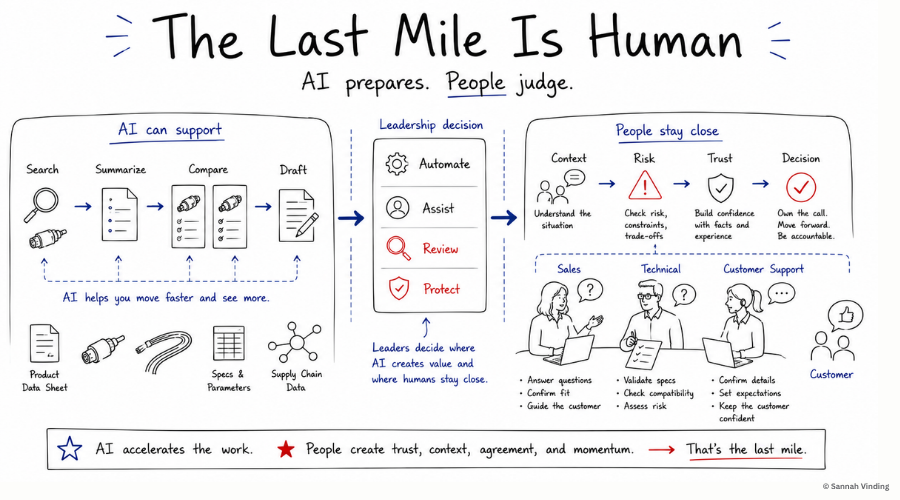
The last mile is where someone checks the context. It is where someone understands the customer. It is where someone knows the difference between a technically correct answer and a useful one.
It is where someone sees the risk.
It is where someone decides whether the recommendation can be trusted.
It is where someone has the conversation that protects the relationship.
AI can get a team closer to the answer faster. But it cannot replace the judgment required to know whether the answer is good enough to use.
That matters in electronics because trust is not built on speed alone.
Trust is built on accuracy, consistency, context, and follow-through.
A faster answer that is wrong does not improve the customer experience. It damages it.
This is why I do not think the goal should be to remove people from every step.
The better goal is to put people in the right steps.
Let AI help with the work that creates friction. Let it support the searching, summarizing, organizing, comparing, and preparing. But keep people close to the moments where judgment, trust, and accountability matter most.
That is the last mile.
Leaders need to decide what to automate, assist, review, and protect
The useful leadership question is not, “Where can we use AI?”
That question is too broad.
A better question is:
Where does AI belong in the flow of work?
The way I would separate it is this.
Some work can be automated because it is repetitive, low risk, rules-based, and easy to verify.
Some work should be assisted because AI can help with research, summaries, drafts, reports, analysis, and internal preparation.
Some work must be reviewed because technical claims, customer-facing answers, product recommendations, substitutions, pricing-related decisions, and accuracy-sensitive outputs need a human in the loop.
Some work should be protected because customer trust, final judgment, strategic decisions, relationship moments, compliance-sensitive work, and decisions someone must stand behind should not be handed off casually.
And some work needs to be improved first because the data is messy, ownership is unclear, handoffs are broken, workflows are undocumented, or teams already disagree on what “good” looks like.
That last category may be the most overlooked.
Sometimes the smartest AI decision is not to automate yet.
It is to fix the process first.
That may not sound as exciting as launching a new tool, but it is often the work that makes AI useful later.
AI adoption starts before the tool
The companies that get real value from AI will not simply be the ones with the most tools.
They will be the ones that understand their work well enough to make better decisions about where AI belongs.
They will know where AI can reduce friction. They will know where it creates risk. They will know which skills people need to build. They will know which handoffs need to change. They will know where human judgment has to stay close to the work.
That is the leadership work.
AI changes tasks before it changes titles. It changes workflows before it changes org charts. It changes how information moves before it changes who owns the role.
For leaders in the electronics supply chain, the opportunity is not to automate everything.
The opportunity is to understand the flow of work, redesign the right parts, and protect the last mile where human judgment still matters.

Sannah Vinding
Engineer | Product Marketing & GTM Systems Leader
I’m an engineer and go-to-market leader with experience across electronics, semiconductors, and advanced manufacturing. I build product marketing, market visibility, and go-to-market systems that connect engineering expertise, customer needs, and commercial growth.
My work focuses on product marketing, AI-enabled execution, customer discovery, and the frameworks that help technical organizations make better decisions, improve execution, and strengthen market visibility.
If this resonated, read these next
Most Growth Problems Are System Problems
In technical B2B organizations, growth often depends less on one campaign or message and more on how well product knowledge, customer insight, technical expertise, and commercial execution connect across the business.
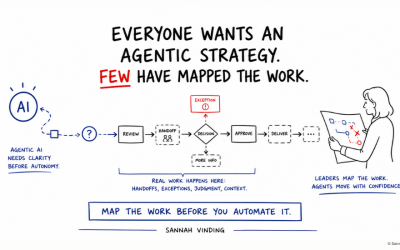
Everyone Wants an Agentic AI Strategy. Few Have Mapped the Work.
Agentic AI will not fix unclear workflows. Leaders need to map how work actually gets done before adding AI agents to the process.
Follow for engineering-driven insight on AI, go-to-market strategy, and B2B growth in complex technical industries.