
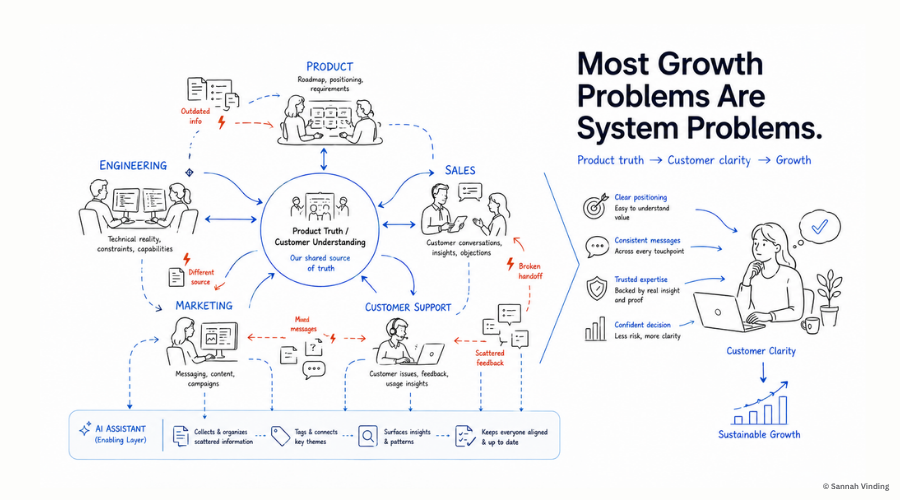
GROWTH BREAKS WHERE KNOWLEDGE GETS STUCK
In technical B2B organizations, growth is often treated as a marketing problem.
The campaign needs to perform better.
The messaging needs to be sharper.
The content needs to generate more leads.
The sales team needs better collateral.
Sometimes that is true.
But many growth problems are not really campaign problems. They are system problems.
They come from how product knowledge, customer insight, technical expertise, market signals, and commercial execution move through the organization. Or more often, how they do not move clearly enough.
In many technical companies, the knowledge is already there. Engineering knows what the product can really do. Product understands the roadmap and tradeoffs. Sales hears what customers are asking, questioning, and comparing. Customer Support sees where confusion shows up after the sale. Marketing is trying to turn all of that into a clear story the market can understand.
The issue is usually not that the company lacks information.
The issue is that the information lives in too many places, across different teams, systems, processes, and versions of the same story.
And eventually, the customer feels that.
69% of B2B buyers report inconsistencies between supplier website information and what sales reps provide.
Source: Gartner
When internal disconnect becomes customer friction
Technical B2B buyers are not just looking for a catchy message. They are trying to understand whether a product, solution, or partner can help them solve a real business or technical problem.
That means they need clarity.
They need to understand what the product does, where it fits, what problem it solves, what tradeoffs matter, and why it is the right choice for their situation.
But when internal knowledge is disconnected, that clarity becomes harder to create.
A buyer may see one thing on the website, hear something slightly different from sales, and find another version in a technical document. They may like the product and believe there is value, but if the information around the product feels unclear or inconsistent, they have to do extra work.
They have to interpret.
They have to validate.
They have to ask more questions.
They have to decide which version they trust.
That slows decisions down.
It also weakens confidence.
Gartner found that 69% of B2B buyers report inconsistencies between supplier website information and what sales reps provide. That is not just a messaging problem. It is a trust problem.
In technical B2B, trust is not built only through relationships. It is also built through consistency, accuracy, and clarity across every place a buyer interacts with the company.
“Growth gets harder when the product knowledge exists, but the system makes clarity difficult.”
Sannah Vinding
Growth depends on how knowledge moves
The companies that execute well are not just creating more content, running more campaigns, or adding more tools.
They are creating better connections between product knowledge, customer needs, market visibility, and commercial execution.
They help teams work from the same information. They make it easier for technical knowledge to become customer clarity. They build repeatable ways to communicate value, instead of recreating the story every time something needs to be launched, explained, or sold.
This is where growth starts to look less like a marketing activity and more like an operating system.
How does information move from Engineering to Product to Sales to Marketing?
How does customer insight move back into product positioning and roadmap conversations?
How does technical expertise become language the market can understand?
How do teams avoid creating five versions of the same product story?
How does the company make sure buyers receive a consistent, useful, and trustworthy message no matter where they start?
These are not just communication questions.
They are growth questions.
70% of B2B buyers prefer a completely digital, self-service buying experience.
Source: Gartner 2026
Digital and AI-mediated buying raise the stakes
This matters even more as B2B buying becomes more digital and more AI-mediated.
Gartner’s 2026 research found that 70% of B2B buyers prefer a completely digital, self-service buying experience, and buyers used an average of seven information sources during a recent purchase.
That does not mean sales becomes less important.
It means the information around the customer has to work harder before a conversation ever happens.
Buyers are researching earlier, comparing faster, using more sources, and forming opinions before they ever speak with a supplier. When they do speak with someone, they are often looking for validation, context, and confidence, not just another version of the brochure.
This changes the role of marketing, sales, product content, and technical communication.
The website, documentation, product pages, articles, webinars, sales conversations, search results, and AI-generated summaries all become part of the same decision environment.
If the product truth is unclear, the market story gets weaker.
If customer insight stays trapped in sales conversations, marketing misses important signals.
If technical knowledge is hard to access, buyers struggle to understand the value.
If internal teams are not aligned, the customer experiences that misalignment externally.
AI can accelerate the system, but it cannot fix the foundation
Many organizations are experimenting with AI, and for good reason. AI can help teams summarize information, draft content, analyze patterns, organize knowledge, and accelerate execution.
But AI does not fix unclear systems.
McKinsey found that 78% of organizations use AI in at least one business function, but only 21% of organizations using generative AI have fundamentally redesigned at least some workflows.
That gap matters.
Because AI can help teams move faster, but faster is not always better if the direction is unclear.
If product data is scattered, AI can surface scattered answers. If positioning is unclear, AI can multiply the confusion. If customer insight is not connected to the workflow, AI will not magically create alignment. If teams are working from different versions of the truth, AI may simply help them move faster in different directions.
This is why the foundation still matters.
Product truth.
Customer understanding.
Strong positioning.
Clear processes.
Shared knowledge.
Consistent execution.
Those are not just marketing inputs. They are growth infrastructure.
“AI can help teams move faster, but faster is not always better if the direction is unclear.”
Sannah Vinding
Engineering-driven growth starts with the system
This is one reason I have become increasingly interested in engineering-driven growth.
My engineering background taught me to look at the whole system. Where does information flow? Where does it get stuck? Where do handoffs break? Where do people have to recreate work because the process is not clear?
My marketing career has taught me that growth rarely comes from one campaign, one launch, or one message. It comes from building repeatable processes that make knowledge easier to access, decisions easier to make, and execution easier to scale.
In technical B2B markets, this is especially important because the product story is often complex. The buyer journey is not always linear. The decision may involve multiple stakeholders, technical requirements, business tradeoffs, and risk considerations.
That complexity cannot be solved by messaging alone.
It requires better systems for turning internal knowledge into external clarity.
A practical place to start
For leaders trying to understand whether a growth challenge is really a system challenge, a few questions can help:
- Where does product knowledge live today?
- Who owns the current version of the product story?
- How does customer insight from Sales and Support make its way back into positioning and content?
- Where do buyers most often get confused?
- Where do internal teams explain the same thing differently?
- What information do customers need before they are ready to speak with sales?
- Where could AI help organize, summarize, or scale knowledge once the process is clearer?
The point is not to make every team sound the same.
The point is to help every team work from the same foundation.
Because when internal knowledge is easier to access, connect, and communicate, customers have an easier time understanding the value.
And when customers understand the value, growth becomes more sustainable.
Most growth problems are not only marketing problems.
In technical B2B, they are often system problems.
And the companies that recognize that have a better chance of building the clarity, trust, and execution needed to grow in an AI-mediated market.
I explored this broader idea in more detail in my framework on engineering-driven B2B growth:

Sannah Vinding
Engineer | Product Marketing & GTM Systems Leader
I’m an engineer and go-to-market leader with experience across electronics, semiconductors, and advanced manufacturing. I build product marketing, market visibility, and go-to-market systems that connect engineering expertise, customer needs, and commercial growth.
My work focuses on product marketing, AI-enabled execution, customer discovery, and the frameworks that help technical organizations make better decisions, improve execution, and strengthen market visibility.
If this resonated, read these next

Preference Forms Before Sales Is Invited
AI is changing when technical buyers form preferences. Sales still matters, but buyers may compare, shortlist, and trust suppliers before the first conversation.
The Focus Problem: Why Electronics B2B Companies Stall After AI
AI removed the build constraint in electronics. Now focus decides which
B2B tech companies and manufacturers turn capability into repeatable revenue and
growth.
Follow for engineering-driven insight on AI, go-to-market strategy, and B2B growth in complex technical industries.