
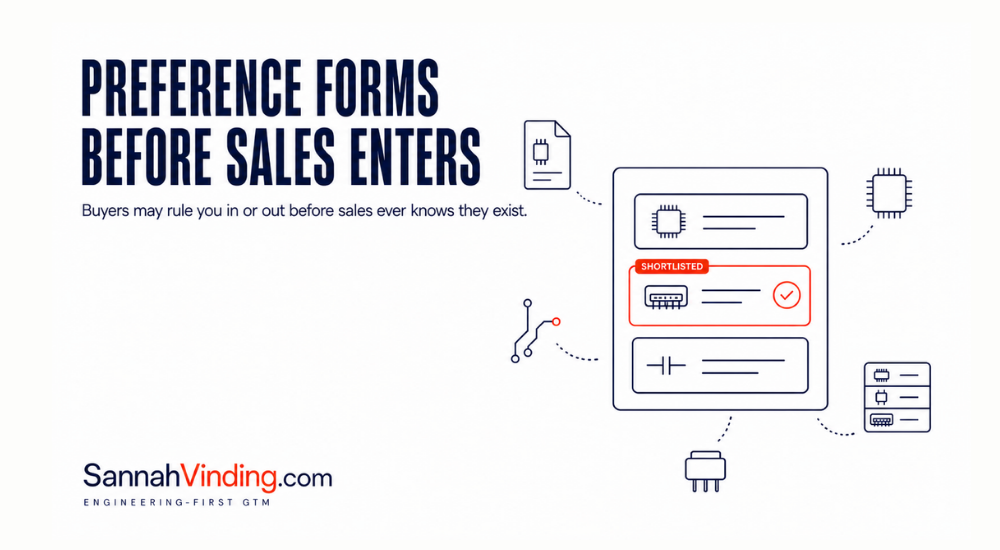
Your Buyer May Have a Preference Before You Have a Lead
There is a quiet shift happening in technical B2B buying.
It is not that sales no longer matters.
It is that sales may be entering the conversation later than many companies realize.
By the time a technical buyer reaches out, asks for a meeting, requests a sample, or sends a quote inquiry, they may already have done a lot of thinking. They may have compared options, looked at alternatives, checked availability, read documentation, asked peers, reviewed distributor listings, and used AI to organize the early research.
That means the first sales conversation is not always the beginning of preference.
It may be the moment when a preference that is already forming gets tested.
That shift is already showing up in buyer behavior.
Gartner reported in 2026 that 67% of B2B buyers prefer a rep-free experience, and 45% used AI during a recent purchase.
That does not mean sales disappears. It means buyers are doing more of the early learning, comparing, and filtering before they invite sales into the conversation.
BUYER BEHAVIOR IS SHIFTING
67% of B2B buyers prefer a rep-free experience.
45% used AI during a recent purchase.
Source: Gartner
The hidden part of the buying journey is getting more important
In technical markets, a lot of work happens before a supplier ever sees the buyer.
The buyer may be trying to answer practical questions like:
-
- Who makes this type of component or solution?
- Which suppliers seem credible for this application?
- What alternatives should we consider?
- What are the risks?
- Which products are available?
- Which company makes this easiest to understand?
- Which option will be easiest to defend internally?
Those questions used to take a lot of manual research. Search results, supplier sites, datasheets, product pages, application notes, distributor pages, peer conversations, internal meetings, and maybe a few early sales calls.
Now AI can sit inside that early research loop.
It can summarize options. It can compare supplier claims. It can pull out missing details. It can help a buyer draft better questions. It can turn scattered information into a first version of a shortlist.
That does not make the final decision automatic. In technical B2B, it should not.
But it does mean early confidence or early doubt can form before the supplier knows there is an opportunity.
That is the part leaders need to pay attention to.
AI does not replace preference. It helps shape it earlier
Preference is not only created in a pitch deck or sales meeting.
It is built through every signal a buyer can access before they talk to a person from your company.
Your product pages contribute to it. Your datasheets contribute to it. Your distributor presence contributes to it. Your application notes, technical articles, sample paths, availability signals, support model, messaging, customer proof, and public expertise all contribute to it.
If those signals are clear and consistent, they help the buyer build confidence.
If they are scattered, outdated, gated, or inconsistent, they create friction.
And in an AI-mediated buying process, friction can show up faster.
That fits what many technical buyers already do. They want control over the early research process. They want to learn before they engage. They want to compare before they commit to a conversation. They want to understand enough to ask better questions.
AI can make that easier.
But easier research does not automatically create better trust.
That depends on the quality of the information AI and the buyer can work with.
BUYING DECISIONS ARE MORE NETWORKED
73% of B2B purchases involve three or more departments
13 internal people
and 9 external participants are involved in the average purchase
Source: Forrester, 2025
Sales still matters, but the conversation changes
This is not an anti-sales argument.
In complex technical markets, people still matter a lot.
A buyer may need help understanding fit for a specific application. They may need context around tradeoffs. They may need someone to explain limitations honestly. They may need support thinking through lifecycle risk, qualification, compliance, supply constraints, regional availability, or internal approval.
That is where sales, application engineering, product, technical support, and distributor partners can create real value.
But the starting point of the conversation may be different.
If a buyer arrives after using AI to compare options, summarize technical proof, identify gaps, and frame the problem internally, they may not need a generic overview. They may need a sharper conversation.
They may already have a preferred option.
They may already have ruled out two others.
They may already have a concern they want answered.
They may already be testing whether the company is as credible as the early research made it seem.
That means the role of sales becomes less about being the first source of information and more about becoming a trusted source of validation, judgment, and next-step clarity.
The last mile is still human.
But the path to that last mile is changing.
“The buyer may meet your information before they meet your people. The question is whether that information is clear enough to earn the next step.”
Sannah Vinding
The buyer may be comparing more than your product
In electronics, semiconductor, manufacturing, and industrial B2B markets, buyers are rarely comparing only a feature list.
They are also comparing confidence.
-
- Can I understand the product quickly enough?
- Can I find the proof I need?
- Can I see where this fits and where it does not?
- Can I tell whether the supplier understands my kind of problem?
- Can I make the internal case to engineering, procurement, quality, operations, finance, or leadership?
- Can I trust the information enough to take the next step?
That is why preference formation is not only a marketing issue. It is a go-to-market system issue.
Forrester’s 2025 buyer research points to how networked B2B buying has become. Their analysis notes that 73% of purchases involve three or more departments, with an average of 13 people inside the buyer’s organization and nine outside involved in making a purchase decision. Buyers are tapping colleagues, communities, peers, and increasingly AI tools before they talk to a provider.
In other words, the buyer is not alone.
The salesperson is not the only influence.
And the website is not the only place where trust forms.
Preference is shaped across a network of people, tools, sources, and internal conversations. If your information cannot travel clearly through that network, your value may not travel clearly either.
“Unclear information does not always create an objection. Sometimes it quietly removes you from consideration.”
Sannah Vinding
Friction can quietly remove you from consideration
One of the most useful things about looking at technical buying through this lens is that it makes friction easier to see.
Inside a company, the information may technically exist.
The datasheet is somewhere. The application note exists. The product manager knows the tradeoffs. Sales knows the common objections. Engineering knows the real limitations. Support knows where customers get confused. The distributor has part of the story. Marketing has another part of it.
But the buyer does not experience your internal knowledge map.
The buyer experiences what they can find, compare, understand, and trust.
EETech’s 2026 Buyer Journey Study, based on a survey of 750 engineers, points to this directly. Engineers self-serve across every stage, and friction at any step can remove a company from consideration. Their study also highlights that the digital experience gap is often quiet: engineers may not say they switched because of a bad website, but the cost shows up as lost consideration.
That is an important point.
Buyers do not always tell you when they ruled you out.
They may simply move on.
Not because your product could not work.
Because another company made the next step easier to understand, easier to compare, or easier to defend.
FRICTION CAN COST YOU CONSIDERATION
Engineers self-serve
across every stage of the buying journey
Friction at any step
can remove a supplier from consideration
Source: EETech, 2026
What would AI say about your company before sales enters?
The useful question is not only, “Are we using AI inside the business?”
That matters, but it is only one side of the shift.
The better external question is:
-
- What would AI help a buyer understand about us before sales enters?
- Would it find clear product truth?
- Would it find consistent technical proof?
- Would it understand where we fit?
- Would it see outdated claims, missing context, or conflicting messages?
- Would it help a buyer build confidence, or would it surface more questions than answers
That does not mean companies should write for AI instead of people.
It means companies need to make their expertise easier for both people and AI systems to interpret. Clear product information. Useful application context. Structured proof. Consistent messaging. Accessible technical resources. Content that helps buyers explain the decision internally.
Machine-readable should not mean machine-owned.
People still own the judgment.
People still own the customer promise.
People still own the trust.
But if buyers are using AI to move faster through the early part of the journey, then unclear information becomes a bigger risk.
The leadership work starts before the lead appears
This is where the work becomes cross-functional.
Marketing cannot solve preference formation alone.
Sales cannot solve it only through better follow-up.
Product cannot solve it only through better specifications.
Engineering cannot solve it by keeping the truth inside technical teams.
Distribution cannot solve it if the supplier story is inconsistent.
The company has to look at how knowledge moves.
Where does product truth live?
Who owns it?
How does technical proof get reviewed?
Where do customer questions show up?
How do sales insights make it back into messaging and documentation?
How easy is it for a buyer, distributor, rep, engineer, procurement person, or AI system to understand what is true, current, and useful?
That is not just content work.
It is GTM infrastructure.
Because if preference forms before sales is invited, then the company needs to earn trust before it sees intent.
Sales still matters.
The human conversation still matters.
But the early work is increasingly shaped by what buyers and AI systems can understand before anyone talks to your team.
The buyer may meet your information before they meet your people.
The question is whether that information is clear enough to earn the next step.
There is a second half to this
Once buyers begin forming preferences before sales is invited, the next question is whether they can find enough clear proof to trust you in the first place.
In an AI-mediated market, buyers and AI tools can help shape the shortlist before anyone picks up the phone. Sales still matters, but visibility, clarity, and trust now have to start earlier.
That second half is the subject of my book, Visible or Invisible, coming this September.

Sannah Vinding
Engineer | Product Marketing & GTM Leader | Author | Podcast Host
I am an engineer and go-to-market leader who has spent my career inside the electronics industry, across manufacturers, distributors, and reps, and in the messy space between a design win and a purchase.
I write about how technical companies earn visibility, trust, and preference in markets where buyers are doing more research before sales ever enters the conversation.
My work connects engineering, product marketing, and GTM systems so companies can make their expertise easier for buyers, teams, and AI tools to understand.
If your company has strong technical expertise but buyers are not seeing it clearly enough, that is exactly the kind of conversation I like having.
If this resonated, read these next
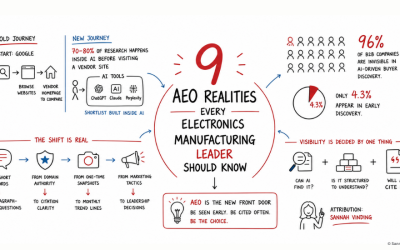
9 AEO Realities Every Electronics Manufacturing Leader Should Know
96% of B2B companies are invisible in AI-driven buying. 9 AEO realities every electronics and manufacturing leader needs to know to stay on the shortlist.
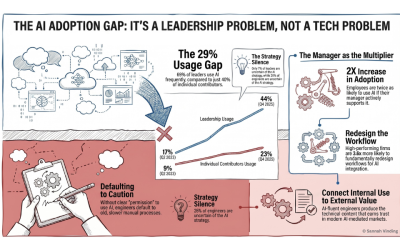
AI Adoption Gap in Manufacturing: A Leadership Problem
Gallup’s 2025 data shows leaders use AI at 69%, engineers at 40%. In manufacturing, that gap has a real cost. Here is what leaders must address first.
BUYERS ARE CHANGING HOW THEY DISCOVER AND TRUST COMPANIES.
FOLLOW FOR PRACTICAL INSIGHTS ON AI, ENGINEERING-FIRST GTM, AND TECHNICAL B2B GROWTH.